
Transcloud
June 3, 2026
June 3, 2026
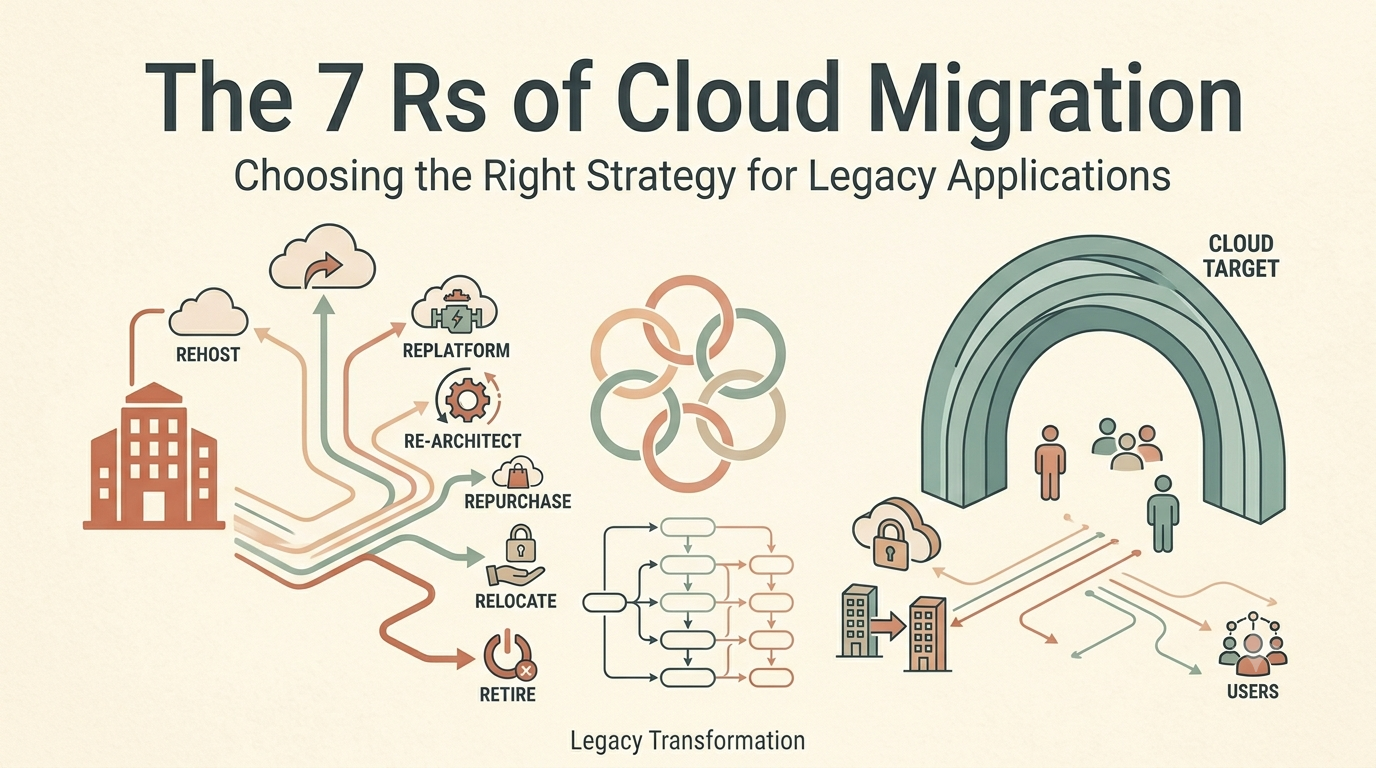
The 7 Rs of cloud migration provide a framework for determining how to move applications from on-premises infrastructure to the cloud. The seven strategies—Retire, Retain, Relocate, Rehost, Replatform, Repurchase, and Refactor—help organizations balance migration speed, cost, risk, and long-term business value. Choosing the right migration approach depends on application complexity, technical debt, compliance requirements, business objectives, and modernization goals.
Cloud migration is no longer simply about moving servers from a data center to a cloud provider. Modern migration projects involve application modernization, cost optimization, security improvements, operational efficiency, and business transformation.
One of the most common reasons cloud migration initiatives fail is that organizations apply the same migration approach to every workload.
Legacy applications differ significantly in architecture, dependencies, business importance, and technical debt. As a result, each application requires a migration strategy aligned with its business and technical requirements.
This is where the 7 Rs framework becomes valuable.
Originally popularized as a structured approach to cloud adoption, the 7 Rs help technology leaders determine the most effective migration path for each application in their portfolio.
The seven migration strategies are:
Rather than selecting one approach for the entire organization, enterprises often use multiple strategies across different workloads.
Many organizations discover that a significant percentage of applications are rarely used, redundant, or no longer deliver business value.
Instead of migrating these applications, the best decision may be to retire them entirely.
A manufacturing company identifies an internal reporting application that has been largely replaced by modern business intelligence tools. Rather than migrating it to the cloud, the application is decommissioned.
Not every application needs to move to the cloud immediately.
Some workloads may need to remain on-premises due to compliance, technical constraints, licensing issues, or business priorities.
A healthcare provider retains a specialized legacy application that relies on proprietary hardware until a modern replacement is available.
Relocation involves moving virtualized workloads to cloud infrastructure without modifying the underlying application architecture.
This strategy is commonly used when migrating virtual machine environments.
An enterprise migrates hundreds of VMware-based workloads to cloud infrastructure while maintaining existing operating models.
Rehosting, often called “lift and shift,” is one of the most widely used migration approaches.
Applications are moved to the cloud with minimal modifications.
A retail company migrates web servers from its data center to AWS without redesigning the application.
Replatforming introduces limited modifications that allow applications to take advantage of cloud-native capabilities while avoiding major redevelopment.
This approach is often described as “lift, tinker, and shift.”
A company migrates an application to Azure and replaces self-managed databases with managed database services.
Repurchasing replaces existing applications with cloud-based software solutions. Instead of migrating the application itself, organizations adopt a software-as-a-service platform.
An organization replaces an on-premises CRM system with a cloud-based CRM platform.
Refactoring involves redesigning applications to fully leverage cloud-native architectures. This strategy typically delivers the greatest long-term business value but requires significant investment.
A SaaS company redesigns a monolithic application into microservices running on Kubernetes across multiple cloud regions.
| Strategy | Migration Speed | Cost | Risk | Cloud Optimization |
| Retire | Very Fast | Very Low | Low | N/A |
| Retain | Immediate | None | Low | None |
| Relocate | Fast | Low | Low | Low |
| Rehost | Fast | Low | Moderate | Low |
| Replatform | Moderate | Moderate | Moderate | Medium |
| Repurchase | Moderate | Moderate | Medium | High |
| Refactor | Slow | High | High | Very High |
Choosing the right migration approach requires evaluating each application individually.
Technology leaders should consider:
How important is the application to daily operations?
How difficult is the application to maintain?
Are there regulatory restrictions that affect migration decisions?
Will future growth require cloud-native capabilities?
How much investment is available for modernization?
How quickly must migration objectives be achieved?
The answers to these questions help determine which migration strategy aligns with business goals.
Different workloads require different migration approaches.
Fast migrations can create long-term inefficiencies.
Hidden dependencies frequently cause migration delays.
Security and compliance planning should begin before migration starts.
Successful cloud migration requires considering people, processes, governance, and operational readiness.
Many successful enterprises follow a phased approach:
The seven strategies are Retire, Retain, Relocate, Rehost, Replatform, Repurchase, and Refactor.
Rehosting is typically the fastest migration approach because it requires minimal application changes.
Refactoring generally provides the greatest cloud-native advantages but requires the most effort.
Yes. Most enterprises apply different strategies to different applications.
Rehosting moves applications with minimal changes, while replatforming introduces targeted optimizations to leverage cloud services.
No. Refactoring should be reserved for applications where the long-term business value justifies the investment.
The 7 Rs of cloud migration provide a practical framework for navigating one of the most complex phases of digital transformation. Rather than forcing every application through the same migration path, organizations can evaluate workloads individually and choose strategies that balance speed, cost, risk, and long-term value.
The most successful cloud migration programs are not those that move everything fastest—they are the ones that align migration decisions with business outcomes.
By understanding when to retire, retain, relocate, rehost, replatform, repurchase, or refactor, technology leaders can build a migration roadmap that supports both immediate objectives and future innovation.