
Transcloud
April 20, 2026
April 20, 2026
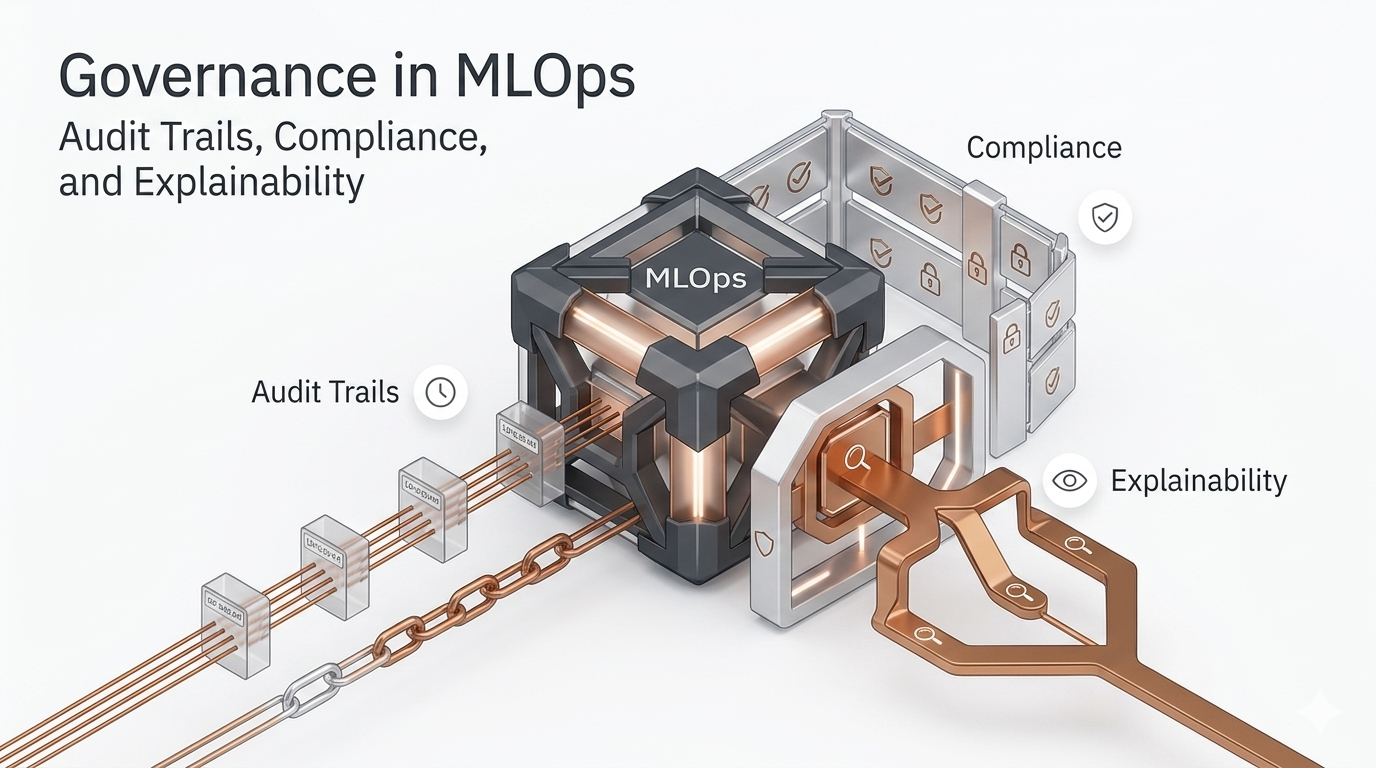
As enterprises operationalize machine learning across products, customer workflows, and internal decision systems, governance becomes one of the most critical pillars of MLOps. Modern ML systems are no longer isolated experiments running inside notebooks—they’re production-grade components influencing credit approvals, fraud detection, supply chain logic, marketing segmentation, and clinical risk scoring. With this impact comes responsibility. Governance ensures that every model entering production is secure, explainable, compliant, and fully traceable throughout its lifecycle.
Most organizations begin with experimentation-heavy ML: quick prototypes, iterative modeling, and ad hoc deployments. But once models touch customer data or influence business decisions, the risk landscape expands. Governance provides the structure needed to manage ML systems consistently across teams. It reduces financial, ethical, and regulatory exposure while enabling faster decision-making through standardization.
Governance frameworks allow organizations to answer fundamental questions: Who trained this model? What data was used? How was it validated? Who approved its release? What does the model do today, and how is that different from when it launched? Without this visibility, organizations are exposed to silent model drift, unexplainable predictions, hidden data leakage, and regulatory violations that may not surface until it’s too late.
Auditability is central to governance. In MLOps, every step—from data ingestion to model serving—must generate structured logs that allow future reviewers to reconstruct what happened. Audit trails create a complete lineage of artifacts and decisions throughout the model lifecycle.
A strong audit trail captures the following:
Platforms like MLflow, Vertex AI, SageMaker, and Azure ML support lineage tracking natively, while tools like Pachyderm, DVC, and LakeFS add version control around data and pipelines. Enterprises must integrate these tools into an auditable, policy-driven workflow to ensure traceability isn’t optional—it’s embedded.
Compliance for ML systems is evolving rapidly. As regulators understand the impact of AI on financial fairness, privacy, security, and consumer experience, organizations must move beyond minimal checklists toward continuous compliance.
Key global and regional compliance frameworks that affect ML include:
Compliance requires robust controls: encryption, access restrictions, retention policies, reproducible experiments, bias testing, documentation, and consent validation. It also demands that ML workflows be transparent and reviewable — a stark contrast to traditional black-box experimentation.
MLOps governance enforces compliance by embedding regulatory requirements into the pipeline itself. Instead of manual checks at the end, compliance becomes continuous, versioned, and automated.
Explainability is not just a technical requirement; it’s a business and legal mandate. Stakeholders across risk, compliance, legal, and product need clarity on how and why models behave the way they do.
Techniques like SHAP, LIME, integrated gradients, and counterfactual explanations help organizations interpret predictions in controlled, structured ways. Explainability solves several enterprise concerns:
In high-stakes workflows, ML must provide a narrative: what drove the decision, what factors were considered, and how confident the model was. Explainability tools become part of automated ML pipelines—not a one-time step before launch.
Governance succeeds only when it is operational. Policies must be translated into technical controls supported by the MLOps platform.
Key components include:
Advanced teams integrate these controls into CI/CD pipelines. The system enforces governance, not individuals. This eliminates inconsistency while reducing friction between data science, ML engineering, and compliance teams.
Organizations often view governance as a regulatory burden, but in reality, it strengthens operational maturity. Companies with strong MLOps governance can deploy models faster because they don’t rely on manual reviews or tribal knowledge. Team onboarding is easier because workflows are clear. Incidents are resolved faster due to structured observability and lineage. Cross-team collaboration improves as departments share a unified source of truth.
Governance transforms ML from isolated experimentation into a durable enterprise capability. It protects the organization legally, financially, and reputationally while enabling stable, scalable model operations.