Enterprise-Scale MLOps Modernization with Kubeflow & MLflow
Executive Snapshot
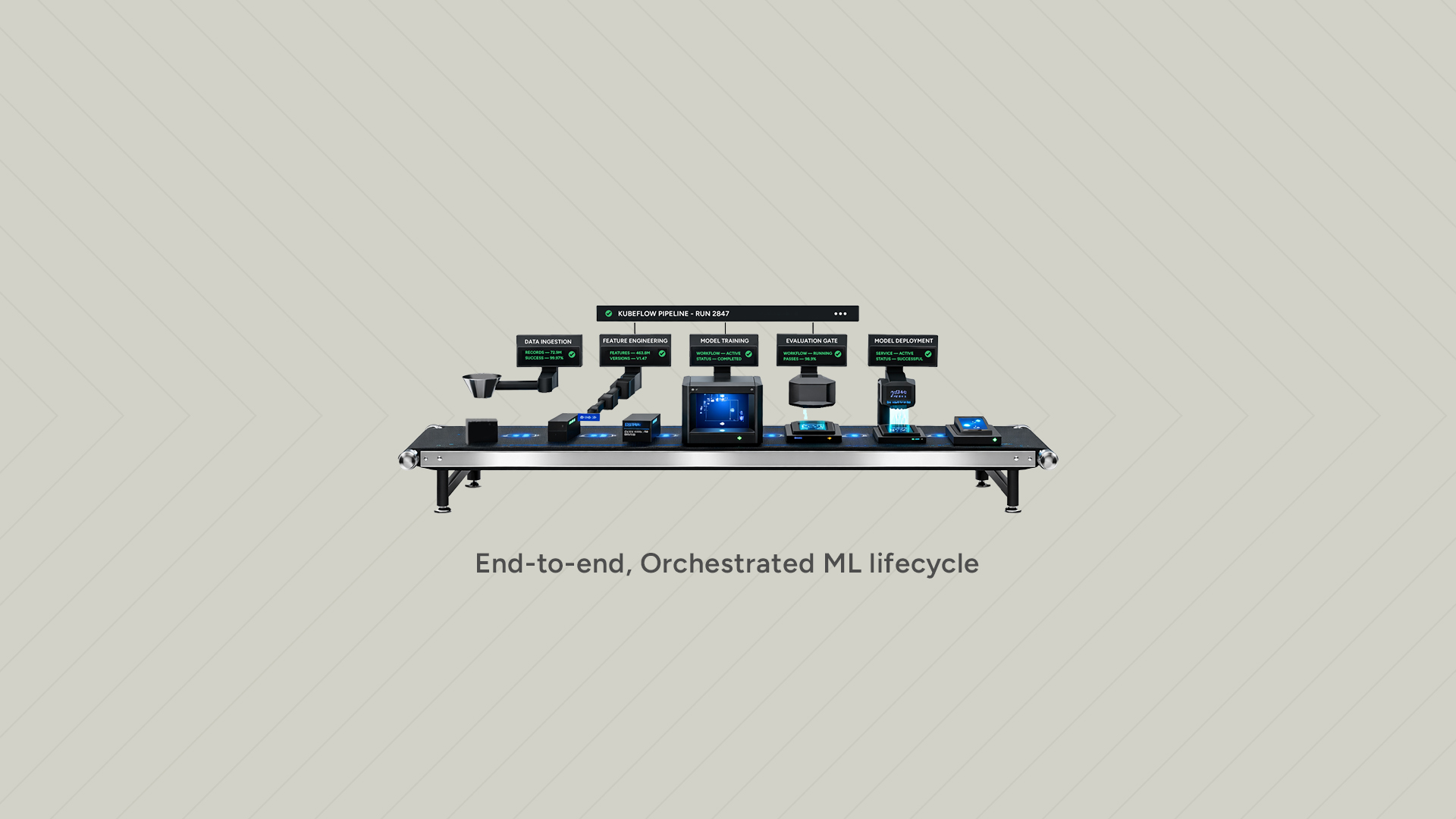
A large enterprise managing a fast-growing portfolio of machine learning models partnered with Transcloud to modernize and standardize its fragmented, manual, and non-scalable MLOps ecosystem. Their on-prem workflows lacked automation, governance, audit readiness, and the ability to support the increasing number of ML initiatives. Transcloud designed and implemented a centralized, automated, production-ready MLOps platform using Kubeflow and MLflow running on Kubernetes – enabling governed collaboration, model traceability, parallelized pipelines, and scalable serving for enterprise workloads.
Key Outcomes:
Centralized platform replacing all manual MLOps activities
Full experiment, model, and dataset traceability with audit-ready lineage
Parallel multi-model execution using Kubeflow Pipelines
Production-ready deployment and autoscaling with KServe
Significant reduction in time-to-production for new models
Enterprise observability with integrated monitoring and metadata tracking
The Challenge
The client operated a large and fast-evolving ML environment with multiple teams developing dozens of models every year. However, their existing approach lacked structure, governance, and automation. As their model volume and complexity grew, their manual MLOps processes became a bottleneck—slowing down deployment, risking inconsistency, and leaving no room for scale or auditability.
They needed a unified, enterprise-ready MLOps platform that could bring standardization, automation, and visibility across experiments, models, datasets, and production serving.
Key Challenges:
No standardized MLOps workflow across teams, resulting in siloed and inconsistent practices
Limited collaboration, with GitLab unable to support secure model sharing or review at scale
No experiment or model tracking, leading to missing metadata, lineage, or reproducibility
Manual versioning, increasing audit risk and operational inconsistency
No data versioning or structured logging, making model rebuilds slow and error-prone
No production-ready serving, lacking autoscaling, monitoring, and standardized deployment workflows
The Solution
Transcloud architected and implemented a unified MLOps platform built on Kubeflow, MLflow, and KServe—transforming the client’s ML lifecycle from manual to fully automated and scalable.
Phase 1 — Standardized Development & Experimentation
Introduced Jupyter Notebooks on Kubernetes for consistent, isolated environments
Centralized experiment tracking in MLflow, capturing parameters, metrics, comparisons, and artifacts
Implemented Kubeflow Pipelines for parallel, repeatable, multi-model workflows
Standardized pipelines for preprocessing → training → evaluation → deployment
Added team-based grouping to structure collaboration and access
Phase 3 — Model Registry & Governance
Built a centralized model registry supporting versioning, promotion, rollback, and reuse
Established clear lineage between datasets, experiments, and production versions
Enabled governance and auditability across the entire lifecycle
Phase 4 — Production Deployment & Observability
Integrated KServe for autoscaled, production-grade serving
Added Prometheus & Grafana for end-to-end model & infrastructure observability
Adopted MinIO for secure artifact and model storage
Prepared for DVC integration to extend dataset lineage capabilities
The Impact
Transcloud’s solution transformed the client’s ML operations from manual and fragmented into a centralized, automated, and enterprise-managed ecosystem. The platform improved speed, governance, and operational efficiency while ensuring full traceability and readiness for high-scale workloads.
Operational & Business Impact
Full traceability across models, datasets, and experiments
The client required a partner capable of combining deep MLOps expertise, enterprise governance, and scalable architecture design. Transcloud brought the technical experience and structured approach needed to modernize and unify their ML operations at scale.
Why the client chose Transcloud:
Proven expertise in MLOps, Kubeflow, MLflow, and Kubernetes-based ML platforms
Strong governance frameworks for model lineage, metadata, and auditability
Ability to design scalable, production-grade serving with KServe and autoscaling
Experience delivering unified, enterprise-ready ML platforms that enhance collaboration and accelerate deployment
Stay Updated with Latest Case Studies
You May Also Like
Establishing Cost Transparency and Cost Reduction Across Amazon EKS
We use cookies to ensure that we give you the best experience on our website. If you continue to use this site we will assume that you are happy with it.Ok