
Transcloud
January 2, 2026
January 2, 2026
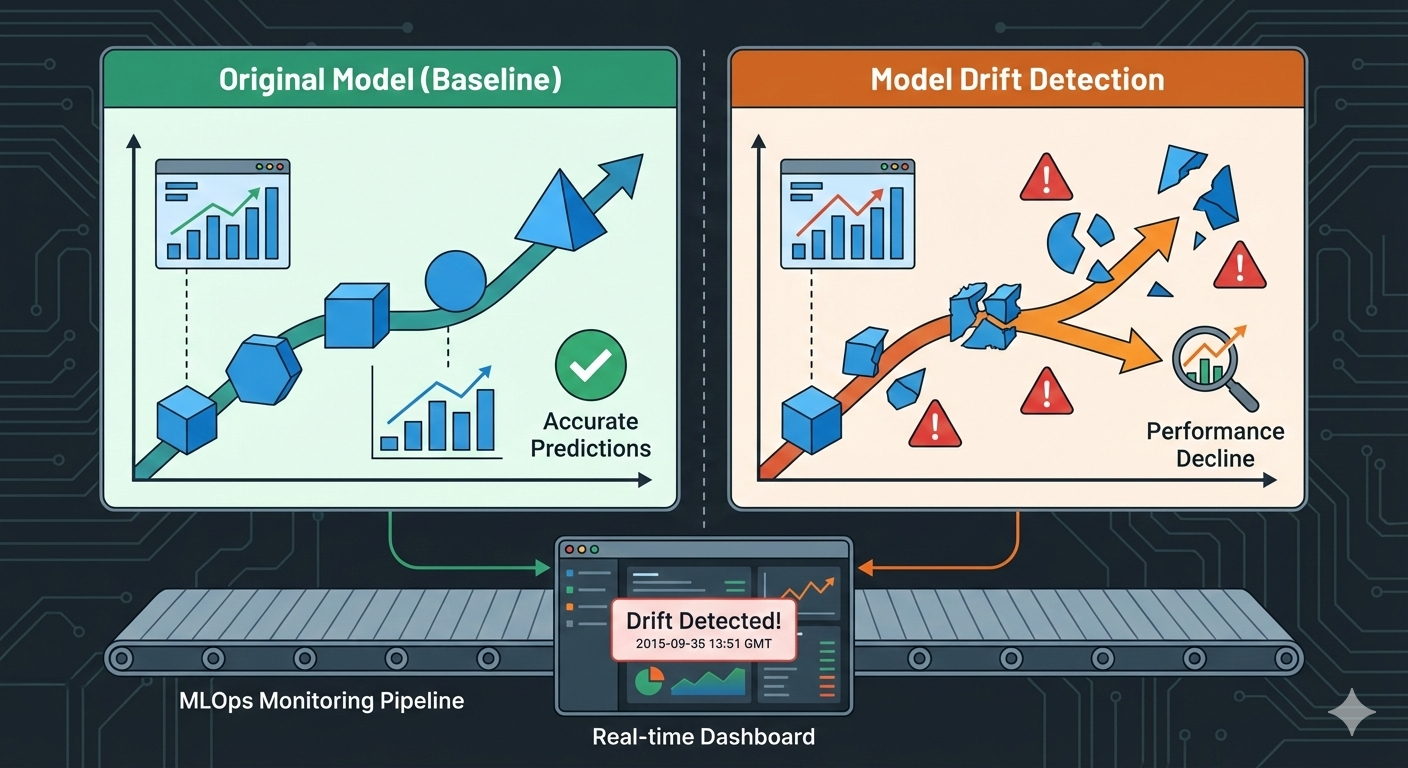
In machine learning, a model’s greatest threat isn’t always poor training — it’s time.
Even the most accurate models degrade silently once deployed, as data, behavior, and environments evolve. This phenomenon, known as model drift, is the quiet destroyer of production AI performance.
Without proper detection and response mechanisms, organizations continue making predictions that no longer reflect reality — leading to inaccurate insights, bad user experiences, and wasted operational costs.
Model drift detection, therefore, isn’t a maintenance task — it’s a core pillar of MLOps that keeps AI aligned with business value over time.
Model drift occurs when the statistical properties of input data or relationships between features and target variables change over time.
In simpler terms, the world changes — but your model doesn’t.
There are two key types of drift:
Both types lead to the same result — accuracy decay. And because drift can happen gradually, it’s often invisible until it starts affecting key metrics or user-facing systems.
The impact of undetected drift isn’t just technical — it’s financial and strategic.
Organizations that neglect monitoring face:
In one case reported by InfoQ (2024), a global fintech saw its credit scoring model’s precision drop by over 18% in six months — purely due to drift in transaction patterns post-market shift.
That’s the essence of “silent decay” — you don’t notice it until it hurts.
Drift detection isn’t about retraining often — it’s about knowing when to retrain.
An effective drift monitoring setup continuously checks whether incoming data or predictions deviate significantly from the baseline (the training data).
These methods ensure that deviations aren’t anecdotal — they’re measurable and actionable.
Drift detection becomes powerful only when it’s automated and connected within the larger MLOps framework.
Here’s how a modern pipeline should look:
Drift detection isn’t an afterthought — it’s a continuous feedback loop that ensures production models evolve alongside real-world data.
While tools help, strategy matters more. The goal is not to chase every small deviation but to define thresholds that align with business tolerance.
Key recommendations include:
With the right governance, teams can ensure continuous learning without constant chaos.
A retail company using demand forecasting models noticed gradual performance decline despite steady data volume. By implementing feature-level drift monitoring with Vertex AI and Evidently AI, they found that regional price sensitivity patterns had shifted after a competitor’s market entry.
With automated retraining triggered through their Kubeflow pipeline, the model’s MAPE (Mean Absolute Percentage Error) improved by 12% within weeks — all without manual intervention.
This demonstrates that drift detection doesn’t just protect models — it enhances their longevity and resilience.
Ignoring drift is like running a factory without checking calibration — things might seem fine until the output fails. In production AI, drift detection is preventive maintenance. It ensures that ML systems continue delivering value as conditions evolve.
Without it, businesses risk turning powerful models into static artifacts that lose relevance with every passing week.
By integrating automated drift detection, alerting, and retraining workflows, enterprises can maintain not only accuracy but trust and accountability in their AI systems.
At Transcloud, we design end-to-end MLOps pipelines that make drift detection seamless — across Google Cloud, AWS, and Azure.
Because in modern AI, success isn’t defined by how good your model is today — but how well it adapts tomorrow.