Transcloud
May 14, 2026
May 14, 2026
In one of the environments we worked with recently, the infrastructure itself was not the issue.
The cloud environment was stable. The Kubernetes clusters were healthy. CI/CD pipelines existed. From the outside, the engineering organization looked mature and operationally sound.
But internally, the teams were slowing down.
Not because of outages.
Not because of architecture failures.
Because of operational repetition.
Engineers were spending increasing amounts of time handling infrastructure requests, searching for internal scripts, waiting on approvals, and manually executing maintenance workflows that had quietly become part of everyday operations.
Nothing looked catastrophic individually.
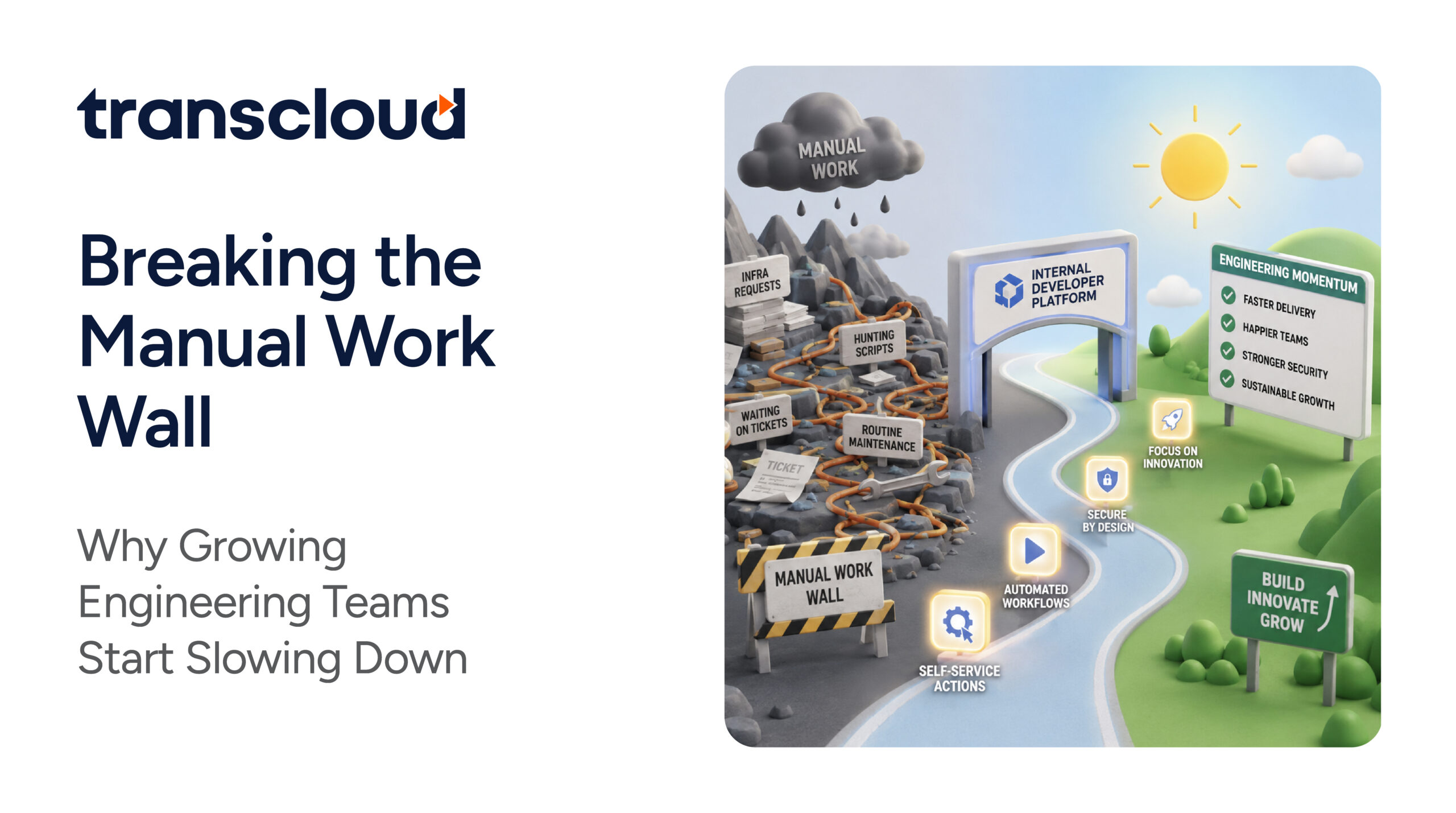
But collectively, the organization had hit the manual work wall. This is a pattern I’ve seen repeatedly across scaling engineering organizations operating in modern cloud-native environments across Amazon Web Services, Microsoft Azure, and Google Cloud Platform.
And it almost always begins the same way.
In the early stages of growth, manual work rarely feels dangerous.
Teams move quickly. Infrastructure requests happen through Slack. Someone manually provisions an environment. A senior engineer runs a maintenance script directly against production because it’s faster than formalizing the workflow.
At that stage, flexibility matters more than operational maturity.
And honestly, that approach often works.
In smaller environments, repetitive operational tasks feel manageable because the same few people understand the systems. There’s very little process overhead, and teams optimize for speed instead of standardization.
But growth changes the equation.
What once took minutes starts consuming hours across engineering and platform teams. Manual environment provisioning, infrastructure approvals, operational scripts, access requests, and repetitive maintenance tasks begin stacking up across the organization.
This is where operational overhead starts becoming visible.
The biggest issue with manual workflows is not usually the work itself.
It’s the accumulation.
I’ve seen highly capable engineering teams spend a significant part of their week:
Individually, these are small operational tasks.
At scale, they become organizational friction.
And over time, that friction directly impacts:
The system still functions. But execution slows underneath it.
That slowdown is subtle at first. Then it becomes structural.
In modern multi-cloud architectures and distributed engineering environments, operational complexity naturally increases as organizations grow.
More services.
More environments.
More infrastructure dependencies.
More operational workflows.
Without workflow standardization and operational automation, teams begin creating their own ways of solving repetitive problems. Scripts become scattered across repositories. Operational knowledge becomes tribal. Routine tasks start depending on specific people instead of repeatable systems.
That is usually the point where scaling starts creating operational drag instead of momentum. And this is where I’ve consistently seen Internal Developer Platforms (IDPs) change the trajectory.
A lot of organizations misunderstand what an Internal Developer Platform really solves.
It’s not just another developer portal.
A well-designed IDP platform standardizes operational workflows and abstracts infrastructure complexity behind self-service automation. It creates what platform engineering teams often call a “paved road”—a secure, repeatable, and standardized path for developers to execute operational tasks without depending on manual coordination.
And that shift changes how engineering organizations operate.
One of the biggest operational problems in growing engineering teams is scattered knowledge.
Critical workflows often live:
An Internal Developer Platform centralizes these operational workflows into a structured service catalog.
Instead of searching for scripts or depending on specific engineers, developers can trigger standardized workflows through self-service interfaces with predefined inputs, automated guardrails, and integrated operational policies.
This dramatically improves:
And more importantly, it removes operational dependency on individual people.
One of the clearest shifts happens when repetitive operational requests stop flowing through Ops teams manually.
Instead of waiting for:
Developers use the IDP to trigger automated workflows directly.
Behind the scenes, the platform handles the infrastructure automation, access controls, approvals, and integrations automatically.
This is where platform engineering, workflow automation, and Infrastructure as Code (IaC) start working together operationally.
Not to replace engineers.
But to eliminate repetitive coordination.
One of the most overlooked advantages of an Internal Developer Platform is security standardization.
In many organizations, operational flexibility eventually creates excessive access sprawl. Engineers receive direct infrastructure access simply because operational tasks depend on it.
That approach does not scale safely.
With proper Role-Based Access Control (RBAC) and workflow abstraction inside an IDP, teams can safely expose operational capabilities without exposing underlying infrastructure directly.
For example:
A junior engineer may need the ability to run a maintenance workflow or restart a service—but they do not need direct SSH access into production systems.
The platform becomes the control layer.
This improves:
Without slowing down engineering execution.
The biggest value of operational automation is not usually time savings.
It’s focus.
When engineering teams stop spending time on repetitive operational maintenance, they redirect that energy toward:
This is where organizations regain momentum.
Because the real cost of manual work is not the minutes lost running scripts. It’s the cumulative loss of high-impact engineering capacity across the organization.
Focus on automating the operational tasks that consume time repeatedly.
Large-scale transformation projects are tempting, but high-frequency micro-tasks—like infrastructure access requests, environment setup workflows, deployment operations, or recurring diagnostics—compound into massive bottlenecks as organizations scale.
By pulling these repetitive workflows into an Internal Developer Platform first, organizations create operational consistency while freeing engineering teams to focus on higher-impact work.
Manual work often feels harmless early on. In smaller teams, it creates flexibility and speed.
But as organizations scale, repetitive operational workflows quietly become one of the largest sources of operational friction inside engineering environments.
The organizations that scale effectively are usually not the ones with the most tooling.
They are the ones that systematically reduce repetitive operational overhead before it becomes embedded into daily engineering work.
Because growth should increase engineering momentum.
Not operational drag.