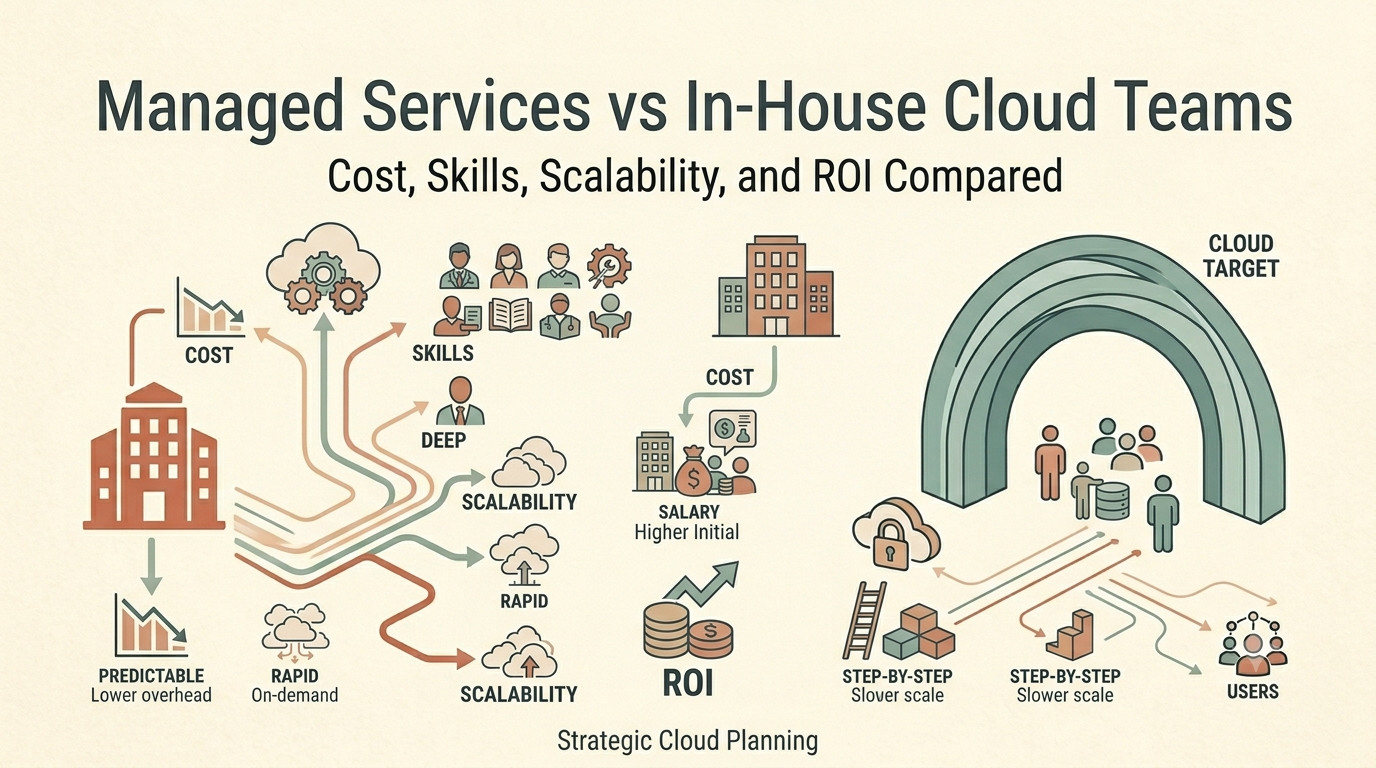
Managed Services vs In-House Cloud Teams: Cost, Skills, Scalability, and ROI Compared

Transcloud

June 5, 2026

Executive Overview:

Choosing between managed cloud services and building an in-house cloud team depends on your organization’s scale, maturity, and strategic priorities. Managed services provide external expertise, operational efficiency, and faster scalability, while in-house teams offer greater control, customization, and long-term capability building. Most enterprises today adopt a hybrid model where core platform ownership remains internal, while operational tasks are partially or fully outsourced.

Key Takeaways

  • Managed services reduce operational burden and accelerate cloud execution.
  • In-house teams offer stronger control and deeper organizational knowledge.
  • Cost differences depend heavily on scale, tooling, and skill availability.
  • Scalability favors managed services in early and mid-stage cloud adoption.
  • Mature enterprises often combine both models.
  • The right choice depends on workload criticality, compliance needs, and internal expertise.

Why This Decision Matters

Cloud adoption has moved beyond infrastructure migration. Enterprises now operate complex multi-cloud environments across AWS, Azure, and Google Cloud Platform (GCP), managing workloads that span analytics, AI, security, and global applications.

As complexity increases, organizations face a key operational question:

Should cloud operations be managed internally, or should they be outsourced to a specialized provider? This decision directly impacts cost efficiency, security posture, scalability, and speed of innovation.

What Are Managed Cloud Services?

Managed cloud services involve outsourcing cloud operations to a third-party provider. These providers handle infrastructure monitoring, security management, cost optimization, patching, incident response, and sometimes full platform operations.

Typical responsibilities include:

  • Infrastructure monitoring and alerting
  • Security management and compliance enforcement
  • Cost optimization and FinOps operations
  • Backup and disaster recovery
  • Performance tuning and scaling
  • Kubernetes and platform management

The goal is to allow internal teams to focus on product development and business strategy rather than infrastructure maintenance.

What Is an In-House Cloud Team?

An in-house cloud team is an internal group of engineers responsible for designing, building, and operating cloud infrastructure.

Typical roles include:

  • Cloud architects
  • DevOps engineers
  • SRE (Site Reliability Engineers)
  • Security engineers
  • Platform engineers

This team builds internal capabilities and maintains full control over cloud environments.

Cost Comparison: Managed Services vs In-House Teams

Cost is often the primary factor in this decision, but the comparison is not straightforward.

Managed Services Cost Structure

Managed services typically involve:

  • Monthly subscription or retainer
  • Usage-based pricing in some cases
  • Tiered support levels

Costs are predictable and scale with consumption.

In-House Team Cost Structure

In-house teams involve:

  • Salaries for specialized engineers
  • Training and certification costs
  • Tooling and licensing expenses
  • Hiring delays and retention risks
  • Operational overhead

Cost Insight

Managed services often appear more expensive per unit of labor, but reduce hidden costs such as downtime, inefficiencies, and under-optimized infrastructure. In-house teams can become cost-effective at scale, but only when fully optimized and well-staffed.

Skills and Expertise Gap

Managed Services Advantage

Managed service providers typically bring:

  • Multi-cloud expertise (AWS, Azure, GCP)
  • Cross-industry experience
  • Specialized knowledge in security and compliance
  • Mature operational frameworks


This reduces the learning curve for organizations adopting cloud at scale.

In-House Challenges

Building internal expertise requires:

  • Significant hiring effort
  • Time to develop cloud maturity
  • Continuous training investment
  • Risk of knowledge silos


Skill shortages in cloud-native technologies remain a common challenge globally.

Scalability and Operational Efficiency

Managed Services

Managed services scale more easily because:

  • Teams are pre-built and standardized
  • Processes are already established
  • Automation frameworks are mature
  • 24/7 coverage is typically included


This makes them ideal for:

  • Rapid cloud expansion
  • Multi-region deployments
  • Startup scaling phases

In-House Teams

In-house scalability depends on:

  • Hiring speed
  • Internal process maturity
  • Tooling investment
  • Organizational structure

Scaling internal teams often lags behind infrastructure growth.

Risk and Control

Managed Services

  • Reduced operational control
  • Dependency on external provider SLAs
  • Potential communication delays in critical incidents
  • Shared responsibility model

In-House Teams

  • Full control over architecture and operations
  • Faster internal decision-making
  • Direct ownership of security posture
  • Better alignment with business logic

Highly regulated industries often prefer in-house or hybrid models for this reason.

ROI Comparison

Return on investment differs based on maturity level.

Managed Services ROI

Higher ROI in:

  • Early-stage cloud adoption
  • Fast-scaling environments
  • Organizations with limited cloud expertise

ROI drivers include reduced downtime, faster deployment, and optimized resource usage.

In-House ROI

Higher ROI in:

  • Large-scale enterprises
  • Stable cloud environments
  • Organizations with strong engineering culture

ROI comes from long-term capability building and reduced vendor dependency.

Head-to-Head Comparison

When to Choose Managed Services

Managed services are typically the right choice when:

  • Cloud maturity is still developing
  • Rapid scaling is required
  • Internal cloud expertise is limited
  • 24/7 operations are needed
  • Multi-cloud environments are complex
  • Focus must remain on product development

When to Choose In-House Teams

In-house teams are preferable when:

  • Cloud infrastructure is business-critical
  • Strong engineering culture already exists
  • Long-term cost optimization is a priority
  • Deep customization is required
  • Regulatory control is strict
  • Strategic ownership of cloud is required

The Hybrid Model (Most Common in 2026)

Most enterprises do not choose one model exclusively.

Instead, they adopt a hybrid approach:

  • In-house teams manage architecture, governance, and security strategy
  • Managed services handle monitoring, scaling, and operational support

This model balances control with efficiency.

Common Mistakes in This Decision

Treating Cost as the Only Factor

Short-term savings often hide long-term inefficiencies.

Underestimating Skill Gaps

Cloud operations require deep, specialized expertise.

Ignoring Operational Complexity

Multi-cloud environments significantly increase management overhead.

Lack of Clear Ownership

Unclear responsibility models lead to delays and incidents.

Decision Framework

A structured approach helps clarify the decision:

  1. Evaluate cloud maturity level
  2. Identify critical workloads
  3. Assess internal skill availability
  4. Define compliance requirements
  5. Estimate scaling needs
  6. Compare total cost of ownership
  7. Decide hybrid vs pure model

Frequently Asked Questions

Are managed cloud services cheaper than in-house teams?

Not always. Managed services reduce hidden operational costs, while in-house teams may become more cost-efficient at scale.

Do enterprises use both models?

Yes. Hybrid operating models are now the most common approach.

Which model is better for startups?

Managed services are usually better for early-stage startups due to speed and cost efficiency.

Which model offers better security?

Both can be secure if properly implemented. In-house teams offer more direct control, while managed services bring standardized security practices.

Can managed services handle multi-cloud environments?

Yes, most modern providers specialize in AWS, Azure, and GCP environments.

Final Thoughts

The decision between managed services and in-house cloud teams is not binary.

It is a spectrum of control, cost, scalability, and operational maturity.

Organizations that are early in their cloud journey benefit from managed services due to speed and expertise. As they mature, they often transition toward in-house capabilities while retaining selective managed support.

The most effective cloud operating model is the one that aligns with business priorities rather than organizational preference.

For most enterprises, a hybrid operating model delivers the best balance between efficiency and control.


Stay Updated with Latest Blogs

    You May Also Like

    Cloud Partnerships for strategic growth, co-creation, and multi-cloud integration in India

    Beyond the SOW: A Strategic Deep Dive into Cultivating High-Value Cloud Partner Relationships Key Takeaways

    September 11, 2025
    Read blog
    Visualizing Rightsizing: A graphic showing a large, underutilized virtual machine (VM) instance being scaled down to a smaller, perfectly utilized size, illustrating how compute optimization reduces wasted cloud resources and saves up to 30% on cloud spend.

    Vendor-Agnostic Managed Services: The Bridge to Resilient Multicloud Operations

    November 12, 2025
    Read blog

    How Enterprises Are Accelerating Multi-Cloud AI Adoption?

    January 6, 2026
    Read blog