Executive Overview:
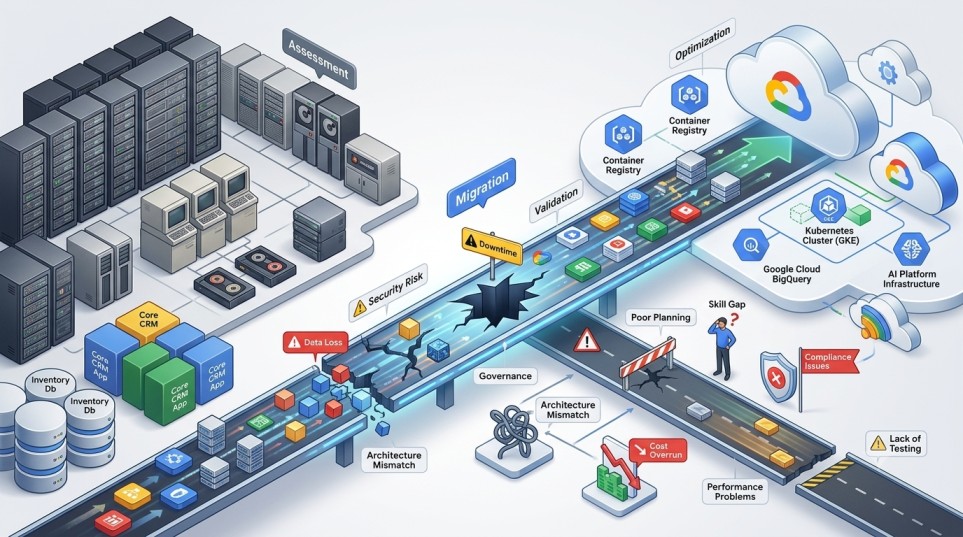
Google Cloud Platform (GCP) migration failures typically occur due to poor planning, underestimated dependencies, lack of cost visibility, and insufficient security governance. The most common mistakes include skipping workload assessment, ignoring network architecture, mismanaging IAM, underestimating data transfer costs, and treating migration as a lift-and-shift exercise instead of a modernization opportunity. Avoiding these issues requires structured planning, FinOps alignment, and a phased migration strategy.
Key Takeaways
- Most GCP migration issues are caused by planning gaps, not platform limitations.
- IAM misconfiguration is one of the highest-risk migration mistakes.
- Data transfer and egress costs are frequently underestimated.
- Network design plays a critical role in migration success.
- Treating migration as simple lift-and-shift leads to inefficiencies.
- A phased, workload-based approach reduces risk significantly.
Why GCP Migrations Fail in Real Enterprises
Migrating to Google Cloud Platform is rarely a simple infrastructure move. Enterprises must deal with application dependencies, security controls, compliance requirements, and cost structures that differ significantly from on-premises or other cloud environments such as AWS and Azure.
While GCP provides strong capabilities in data analytics, Kubernetes (GKE), and AI/ML services, migration projects often fail when organizations underestimate complexity or assume cloud parity across providers.
Understanding common mistakes helps reduce risk and improve migration success rates.
Mistake 1: Skipping Application Discovery and Dependency Mapping
One of the earliest and most damaging mistakes is starting migration without a complete application inventory.
What goes wrong
- Hidden service dependencies are missed
- Databases and APIs are not mapped
- Downstream systems break after migration
Impact
- Migration delays
- Production outages
- Increased rework costs
How to avoid it
Use automated discovery tools and dependency mapping before planning migration waves. Every application should be evaluated for upstream and downstream dependencies.
Mistake 2: Treating Migration as Simple Lift-and-Shift
Many organizations attempt to move workloads to GCP without redesigning architecture.
What goes wrong
- Legacy inefficiencies are carried forward
- Performance issues persist in cloud
- Cost optimization opportunities are missed
Impact
- Higher long-term operational costs
- Limited cloud-native benefits
- Reduced scalability
How to avoid it
Adopt the 7 Rs migration framework and evaluate whether each workload should be rehosted, replatformed, or refactored.
Mistake 3: Underestimating Network Architecture Complexity
GCP network design differs significantly from on-prem and other cloud providers.
What goes wrong
- Poor VPC design
- Incorrect subnet planning
- Latency issues between services
- Lack of hybrid connectivity planning
Impact
- Application performance degradation
- Security vulnerabilities
- Integration failures
How to avoid it
Design network architecture early, including:
- VPC structure
- Hybrid connectivity (VPN / Interconnect)
- Firewall rules
- Service-to-service communication patterns
Mistake 4: Ignoring IAM and Access Control Design
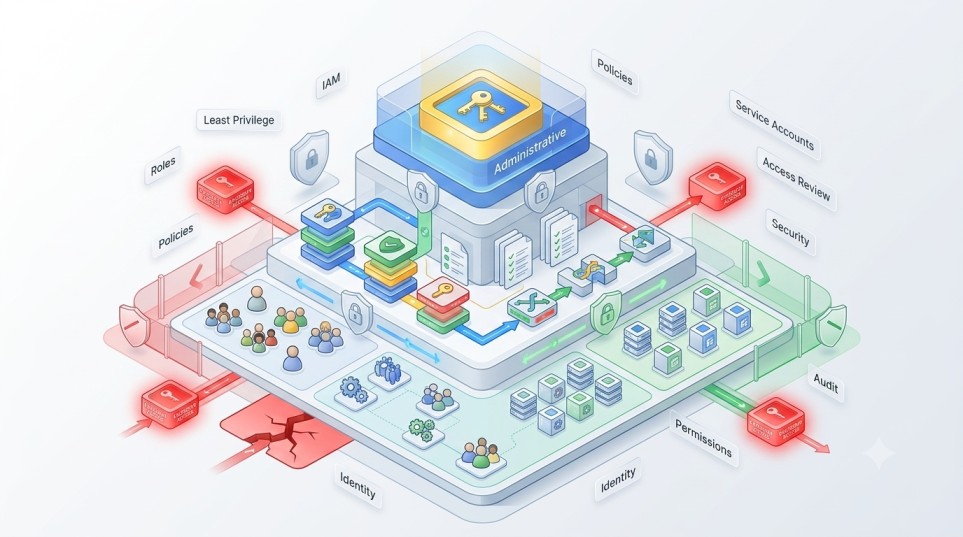
Identity and Access Management (IAM) is often misconfigured during migration.
What goes wrong
- Over-permissioned service accounts
- Lack of role-based access control
- Misaligned organizational policies
Impact
- Security vulnerabilities
- Compliance risks
- Unauthorized access exposure
How to avoid it
Implement least privilege access principles and design IAM roles before workload migration begins.
Mistake 5: Underestimating Data Transfer and Egress Costs
One of the most overlooked cost drivers in GCP migrations is data movement.
What goes wrong
- Large-scale data transfers between clouds
- Frequent cross-region communication
- Poor storage class planning
Impact
- Unexpected billing spikes
- Budget overruns
- Inefficient architecture decisions
How to avoid it
Model data flows before migration and optimize:
- Storage classes (Standard, Nearline, Coldline)
- Region selection
- Cross-cloud traffic patterns
Mistake 6: Migrating Without FinOps Visibility
Many organizations migrate workloads without cost governance frameworks in place.
What goes wrong
- No tagging strategy
- No budget tracking
- No workload-level cost visibility
Impact
- Invisible cloud spend
- Lack of accountability
- Poor optimization decisions
How to avoid it
Implement FinOps practices from day one, including:
- Cost allocation tagging
- Budget alerts
- Workload-level reporting
Mistake 7: Poor Use of Managed Services
GCP offers managed services like Cloud SQL, BigQuery, and GKE, but many teams underutilize them.
What goes wrong
- Self-managed infrastructure used unnecessarily
- Operational overhead increases
- Missed scalability benefits
Impact
- Higher maintenance cost
- Reduced reliability
- Slower innovation
How to avoid it
Prefer managed services unless there is a strong technical or compliance reason not to use them.
Mistake 8: Lack of Security Baseline Before Migration
Security is often treated as a post-migration activity.
What goes wrong
- No baseline policies
- Inconsistent encryption
- Missing logging and monitoring
Impact
- Security gaps during migration
- Audit failures
- Exposure of sensitive workloads
How to avoid it
Establish a security baseline including:
- Cloud Logging and Monitoring
- IAM policies
- Encryption standards
- Organization-level policies
Mistake 9: Ignoring Kubernetes and GKE Complexity
GKE is a powerful service, but migration to Kubernetes without expertise leads to issues.
What goes wrong
- Poor cluster design
- Misconfigured autoscaling
- Networking misalignment
Impact
- Application instability
- Increased latency
- Operational complexity
How to avoid it
Standardize Kubernetes architecture before migration and define cluster management policies.
Mistake 10: No Post-Migration Optimization Phase
Many organizations treat migration as the final step.
What goes wrong
- No performance tuning
- No cost optimization
- No workload right-sizing
Impact
- Higher long-term costs
- Suboptimal performance
- Wasted cloud resources
How to avoid it
Implement a post-migration optimization phase covering:
- Cost optimization (FinOps)
- Performance monitoring
- Security audits
- Resource rightsizing
GCP Migration Mistake Severity Overview
GCP Migration Best Practices
1. Start with workload discovery
Understand application dependencies before planning migration.
2. Use phased migration waves
Avoid large-scale “big bang” migrations.
3. Prioritize managed services
Reduce operational overhead wherever possible.
4. Design IAM early
Security must be embedded from the start.
5. Implement FinOps from day one
Cost visibility should not be an afterthought.
6. Optimize post-migration
Treat migration as a continuous improvement process.
Frequently Asked Questions
What is the biggest mistake in GCP migration?
Skipping application dependency mapping is one of the most critical mistakes.
Is lift-and-shift a good strategy for GCP?
It can be used for speed, but it often leads to higher long-term costs.
How do you reduce GCP migration costs?
Use managed services, optimize data transfer, and apply FinOps governance.
What tools help with GCP migration?
Google Cloud Migration Center, Velostrata (legacy), and third-party discovery tools.
Is GCP migration harder than AWS or Azure?
Complexity is similar; differences lie in service architecture and networking models.
Final Thoughts
GCP migration success depends less on tooling and more on execution discipline.
Organizations that plan for dependencies, security, cost governance, and post-migration optimization consistently achieve better outcomes than those focusing only on infrastructure movement.
A structured, phased approach aligned with FinOps and security best practices significantly reduces migration risk and improves long-term cloud efficiency.