Executive Overview:
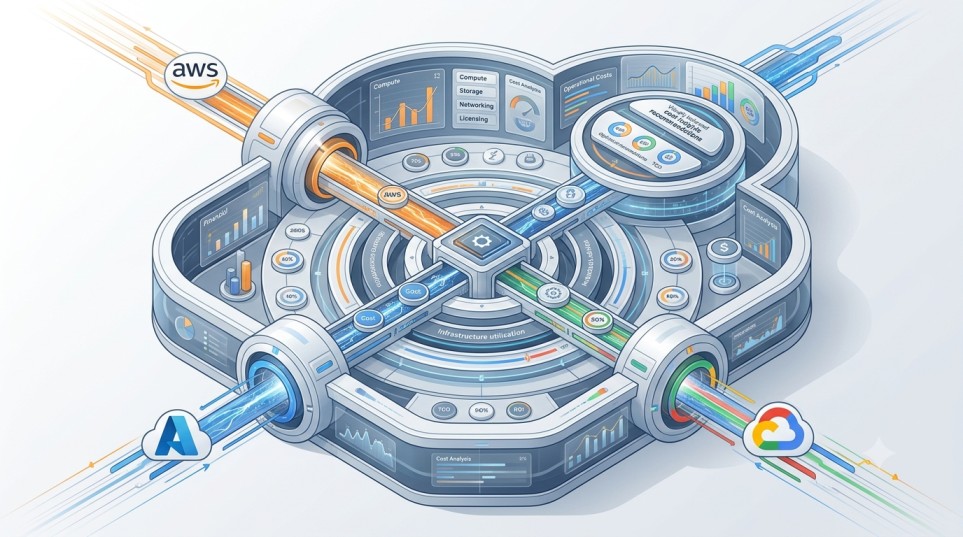
A Cloud Total Cost of Ownership (TCO) calculator framework is a structured method for estimating and comparing the real cost of running workloads across AWS, Azure, and Google Cloud Platform (GCP). It goes beyond compute pricing and includes storage, networking, data transfer, licensing, operations, security, and hidden costs such as idle resources and management overhead. Accurate TCO comparison requires workload-based modeling rather than simple price list comparisons.
Key Takeaways
- Cloud pricing comparisons are misleading without TCO modeling.
- AWS, Azure, and GCP differ significantly in hidden cost structures.
- Data transfer and egress are major cost drivers.
- Operational and staffing costs are often underestimated.
- Workload-based modeling is more accurate than service-level comparison.
- FinOps discipline is required for reliable TCO decisions.
Why Cloud TCO Calculation Is Difficult
Comparing cloud providers is not a straightforward pricing exercise. While AWS, Azure, and GCP all publish pricing calculators, these tools typically focus on infrastructure costs and ignore real-world complexity.
Enterprises often fail to account for:
- Cross-region data transfer
- Multi-service dependencies
- Licensing differences
- Operational overhead
- Security and compliance tooling
- Idle and underutilized resources
As a result, initial cost estimates often diverge significantly from actual bills.
A proper TCO framework is required to close this gap.
What Is Cloud TCO?
Total Cost of Ownership (TCO) in cloud computing includes all direct and indirect costs associated with running workloads in the cloud.
It typically includes:
- Compute (VMs, containers, serverless)
- Storage (block, object, archival)
- Networking (load balancers, NAT, bandwidth)
- Data transfer (ingress/egress, inter-region traffic)
- Managed services (databases, analytics, AI)
- Security and compliance tools
- Operational costs (monitoring, DevOps, support)
- Licensing (OS, enterprise software)
- Human resource costs (engineering and management effort)
Core Components of a Cloud TCO Model
1. Compute Costs
Compute is the most visible cost but not always the largest.
Key variables:
- Instance type
- Usage duration
- Autoscaling behavior
- Reserved vs on-demand pricing
AWS, Azure, and GCP all offer different discount models such as savings plans, reservations, and committed use discounts.
2. Storage Costs
Storage pricing varies based on:
- Type (block, object, archive)
- Redundancy model
- Access frequency
Cold storage is cheaper but introduces retrieval costs that impact TCO.
3. Network and Data Transfer Costs
One of the most underestimated cost areas.
Includes:
- Internet egress
- Cross-region replication
- Cross-zone communication
- Load balancer traffic
Even small architectural differences can significantly impact monthly costs.
4. Managed Services Costs
Managed services reduce operational overhead but may increase direct costs.
Examples:
- AWS RDS vs self-managed databases
- Azure SQL Database vs VM-based SQL Server
- BigQuery vs traditional data warehouses
5. Operational Costs (Hidden Layer)
Operational costs often dominate long-term TCO:
- DevOps engineering effort
- Monitoring and incident response
- Security management
- Backup and disaster recovery
These are often ignored in simple calculators.
6. Licensing Costs
Licensing differs across clouds:
- Windows Server licensing
- SQL Server licensing
- Enterprise software subscriptions
Azure often includes licensing advantages for Microsoft workloads.
Cloud TCO Comparison Challenges
1. Pricing Model Differences
Each provider structures pricing differently:
- AWS: granular, pay-as-you-go focused
- Azure: strong hybrid + enterprise agreements
- GCP: sustained usage discounts and simplicity focus
2. Hidden Cost Variability
Costs vary based on architecture design, not just provider.
Example:
Two identical applications can have different costs based on:
- Network routing
- Storage architecture
- Service selection
3. Discounting Models
Each provider offers different discount mechanisms:
- AWS Savings Plans / Reserved Instances
- Azure Reservations / Hybrid Benefit
- GCP Committed Use Discounts / Sustained Use Discounts
These impact long-term TCO significantly.
Cloud TCO Calculator Framework (Step-by-Step)
Step 1: Define Workload Profile
Identify:
- Application type (web, database, analytics)
- Traffic patterns
- Storage requirements
- Geographic distribution
Step 2: Map Architecture Components
Break down into:
- Compute layer
- Data layer
- Network layer
- Security layer
Step 3: Estimate Resource Utilization
Avoid assuming 100% utilization.
Consider:
- Peak vs average usage
- Autoscaling patterns
- Seasonal variations
Step 4: Apply Pricing Models per Cloud
Map each component to:
- AWS equivalent services
- Azure equivalents
- GCP equivalents
Step 5: Include Data Transfer Flows
Model:
- Inbound traffic
- Outbound traffic
- Cross-region communication
This step often changes final TCO outcomes significantly.
Step 6: Add Operational Costs
Estimate:
- Engineering effort
- Monitoring tools
- Incident management overhead
Step 7: Apply Discount Structures
Include:
- Reserved pricing
- Enterprise agreements
- Committed usage discounts
Step 8: Calculate 3-Year TCO
A meaningful comparison requires long-term projection:
- Year 1: migration + onboarding
- Year 2–3: steady-state operations
Common TCO Calculation Mistakes
Ignoring Data Transfer Costs
Often the largest surprise cost in cloud bills.
Comparing Services Instead of Workloads
TCO must be workload-based, not service-based.
Excluding Operational Costs
Engineering time is a major cost driver.
Overestimating Reserved Capacity Savings
Reserved pricing only works with predictable workloads.
Ignoring Multi-Cloud Complexity
Multi-cloud increases:
- Integration overhead
- Security management costs
- Operational complexity
Best Practices for Accurate Cloud TCO
1. Use Workload-Based Modeling
Do not compare individual services in isolation.
2. Include 3-Year Projection
Short-term pricing is misleading.
3. Factor in Engineering Costs
People cost is part of cloud TCO.
4. Simulate Real Traffic Patterns
Avoid static usage assumptions.
5. Recalculate Regularly
Cloud environments evolve continuously.
When TCO Analysis Is Most Important
- Cloud migration planning
- Multi-cloud strategy decisions
- Application modernization planning
- Vendor comparison for enterprise procurement
- FinOps optimization initiatives
Frequently Asked Questions
What is cloud TCO? It is the total cost of running workloads in the cloud, including infrastructure, operations, licensing, and hidden costs.
Why is AWS vs Azure vs GCP cost comparison difficult? Because pricing models, discounts, and architectural impacts differ significantly.
Which cloud is cheapest? There is no universal winner; cost depends on workload design.
What is the biggest hidden cost in cloud? Data transfer and operational overhead are often the largest hidden costs.
How long should TCO be calculated for?
Typically 3 years for enterprise decision-making.
Final Thoughts
Cloud TCO comparison is not a pricing exercise; it is an architectural and operational modeling exercise.
Enterprises that rely on simple calculators often underestimate real costs and make suboptimal decisions. A structured framework that includes workload modeling, data transfer analysis, operational overhead, and discount structures provides a far more accurate view.
In multi-cloud environments, TCO becomes not just a financial tool but a strategic decision-making framework for long-term cloud adoption and governance.