AWS vs Azure vs GCP for Enterprise Workloads: A Decision Framework for 2026
Transcloud
June 24, 2026
Executive Overview:
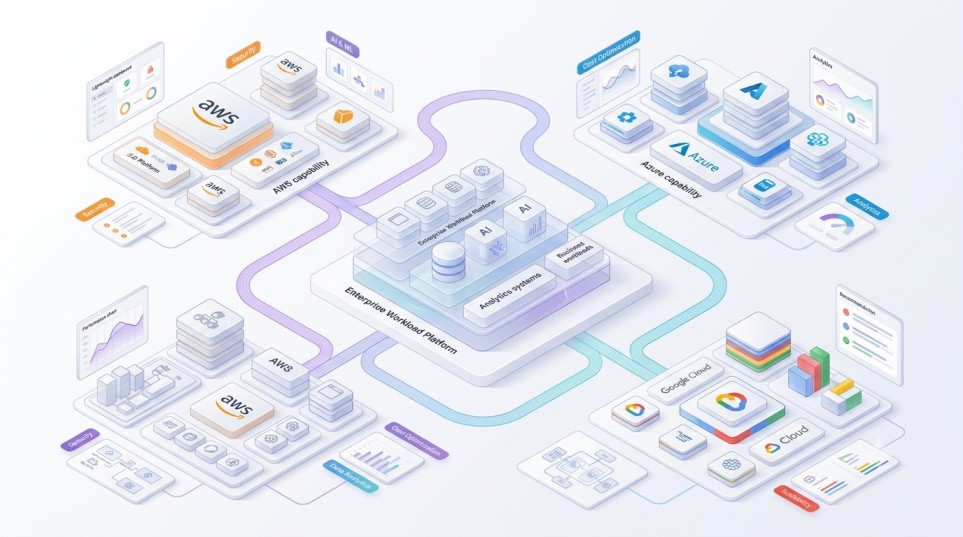
AWS, Azure, and Google Cloud Platform (GCP) all support enterprise-grade workloads, but they differ in ecosystem strength, pricing structure, AI/ML capabilities, hybrid cloud support, and operational complexity. AWS leads in service breadth and maturity, Azure dominates in Microsoft-heavy enterprise environments and hybrid deployments, and GCP is strongest in data analytics, Kubernetes, and AI-driven workloads. The right choice depends on workload type, existing enterprise stack, and long-term architecture strategy rather than raw feature comparison.
Key Takeaways
AWS is strongest for broad enterprise infrastructure maturity and global service coverage.
Azure is preferred for Microsoft-centric enterprises and hybrid cloud setups.
GCP excels in data, analytics, Kubernetes, and AI workloads.
No single provider is universally cheapest or best.
Enterprise decisions must be workload-driven, not vendor-driven.
Multi-cloud adoption is increasingly standard for large organizations.
Why Enterprise Cloud Selection Is Complex
Choosing a cloud provider for enterprise workloads is no longer a simple cost or feature comparison. Modern architectures involve distributed systems, multi-region deployments, compliance constraints, and AI-driven workloads.
Enterprises must evaluate:
Existing technology stack
Compliance and regulatory requirements
Talent availability
Operational maturity
Long-term scalability requirements
Vendor lock-in risk
As a result, cloud selection becomes a strategic architecture decision rather than a procurement choice.
AWS vs Azure vs GCP: High-Level Positioning
AWS (Amazon Web Services)
AWS is the most mature and widely adopted cloud platform globally.
Strengths:
Largest service catalog
Strong global infrastructure footprint
Mature DevOps and serverless ecosystem
Broad enterprise adoption
Common enterprise use cases:
Large-scale web applications
Microservices architectures
Global SaaS platforms
Infrastructure-heavy workloads
Azure (Microsoft Azure)
Azure is deeply integrated with Microsoft enterprise ecosystems.
Strengths:
Seamless integration with Windows Server, Active Directory, and Office 365
AI or pricing trends often distort decision-making.
Ignoring existing ecosystem
Microsoft-heavy enterprises often struggle outside Azure.
Underestimating migration cost
Migration complexity often exceeds initial estimates.
Focusing only on compute pricing
True cost includes networking, storage, and operations.
Not planning for multi-cloud
Most large enterprises eventually adopt multi-cloud models.
Recommended Decision Framework
Step 1: Identify workload categories
Group workloads into:
Legacy enterprise systems
Cloud-native applications
Data and analytics platforms
AI/ML workloads
Step 2: Map ecosystem dependencies
Evaluate:
Identity systems
ERP and enterprise tools
Developer stack
Step 3: Evaluate compliance constraints
Include:
Data residency requirements
Industry regulations
Internal governance rules
Step 4: Perform TCO modeling
Compare workloads using a 3-year cost framework rather than per-service pricing.
Step 5: Define multi-cloud boundaries
Decide:
Primary cloud
Secondary cloud (if required)
Workload distribution logic
When to Choose Each Cloud
Choose AWS when:
You need maximum service breadth
You are building global-scale applications
You require advanced infrastructure control
Choose Azure when:
You are a Microsoft-centric enterprise
You require hybrid cloud architecture
You operate in regulated industries
Choose GCP when:
Data analytics is core to business
AI/ML workloads are strategic
Kubernetes-native architecture is preferred
Frequently Asked Questions
Which cloud is best for enterprise workloads?
There is no universal best choice; it depends on workload type and enterprise ecosystem.
Is AWS more expensive than Azure or GCP?
Not inherently; cost depends on architecture, usage, and discounts.
Which cloud is best for AI?
GCP is strong in Vertex AI, while AWS and Azure also provide competitive AI platforms.
Can enterprises use all three clouds?
Yes, multi-cloud is increasingly common in large organizations.
What is the biggest decision factor?
Workload alignment and ecosystem compatibility matter more than pricing.
Final Thoughts
Enterprise cloud selection in 2026 is fundamentally a workload and architecture decision rather than a vendor comparison exercise.
AWS, Azure, and GCP each lead in different domains, and most mature enterprises end up using a combination of all three.
A structured decision framework based on workload type, ecosystem dependency, compliance needs, and TCO modeling produces far more reliable outcomes than feature-based comparison alone.
Stay Updated with Latest Blogs
You May Also Like
How a Retail Giant Reduced Forecasting Errors with MLOps
We use cookies to ensure that we give you the best experience on our website. If you continue to use this site we will assume that you are happy with it.Ok