
Transcloud
September 24, 2026
September 24, 2026
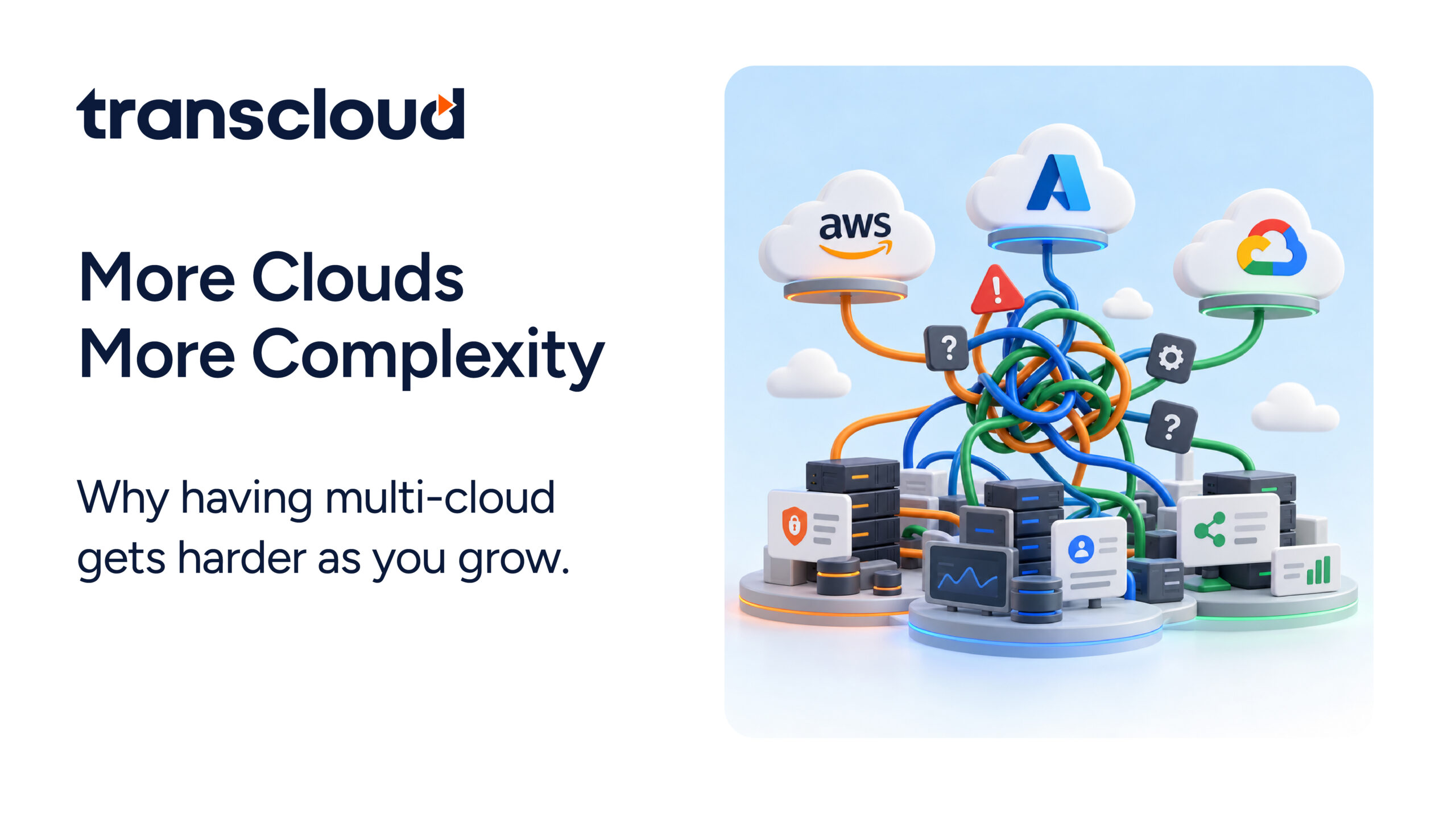
Multi-cloud rarely begins with a multi-cloud strategy.
It usually begins with a practical decision. A company acquires a business that already runs on another provider. A customer requires workloads to be hosted on a specific platform. An engineering team adopts a cloud service that fits a new application particularly well. A regional requirement changes where workloads need to run.
Over time, these decisions accumulate.
What started as a few isolated workloads can eventually become an environment spanning AWS, Azure, Google Cloud, and sometimes on-premises infrastructure as well. At that point, the question is no longer which cloud provider should host the next application. The question becomes how the organization will operate all of them without creating a separate set of processes for every environment.
That’s where multi-cloud starts becoming an operational challenge.
The infrastructure itself is rarely the immediate problem. Cloud providers are capable of running highly complex workloads at scale. The difficulty comes from everything surrounding those workloads: how teams deploy them, how access is managed, how security policies are enforced, how incidents are investigated, and how engineers understand what is happening across the entire environment.
Consider something as fundamental as identity.
A growing organization may have different identity structures across its cloud providers. AWS uses IAM, Azure has Microsoft Entra ID and Azure RBAC, and Google Cloud uses Cloud IAM. Each platform provides sophisticated controls, but the way permissions are structured and managed isn’t identical.
That difference matters when an organization tries to establish consistent access policies.
The same principle applies to networking. AWS VPCs, Azure Virtual Networks, and Google Cloud VPCs all provide the capabilities needed to build secure networks, but their architectures, terminology, and configuration models differ. An engineer moving between environments isn’t simply learning a new interface. They’re working with different abstractions for solving similar infrastructure problems.
The same pattern appears in logging, monitoring, secrets management, security controls, backup, and infrastructure automation.
None of these differences are inherently bad.
They become a problem when every difference creates a separate operational process.
This is where organizations can start accumulating what we would call a multi-cloud management tax. Engineers spend more time maintaining provider-specific knowledge. Security teams have to validate controls across multiple environments. Operations teams maintain different monitoring workflows. Developers encounter different deployment processes depending on where their application happens to run.
The number of clouds may only increase by one.
The number of things the organization has to manage can increase by much more.
This also changes how teams troubleshoot problems.
In a single-cloud environment, engineers generally have a familiar set of services, logs, dashboards, and network paths to work through. In multi-cloud environments, an application can cross provider boundaries. A request might originate in one environment, pass through another network, reach a service hosted by a different provider, and depend on an identity or data service somewhere else.
When something goes wrong, the investigation isn’t necessarily about finding a broken component.
It’s about understanding the entire path.
That makes observability particularly important. Having monitoring on every individual cloud isn’t the same as having visibility across the environment. Teams need to understand application health, infrastructure behavior, network dependencies, and security events without having to manually assemble the picture from several provider-specific systems.
The same principle applies to governance.
As environments expand, organizations often create cloud-specific standards independently. One team establishes a naming convention in AWS. Another develops tagging requirements in Azure. A third creates its own approach in Google Cloud. All of these standards may be reasonable, but the organization eventually ends up with three different interpretations of what good infrastructure management looks like.
That makes governance harder to scale.
The answer isn’t necessarily to force every cloud into an identical architecture. Doing that can create unnecessary constraints and prevent teams from taking advantage of capabilities that are specific to each provider.
A better approach is to standardize the operating principles while allowing implementation to remain cloud-specific.
For example, an organization can establish a common requirement for least-privilege access without requiring identical IAM configurations across providers. It can define common logging and retention requirements while using each provider’s native logging capabilities. It can establish consistent tagging, ownership, and cost-allocation principles while allowing the underlying resource structures to differ.
The distinction is important.
Standardization should define what the organization expects.
Cloud-native implementation determines how those expectations are achieved.
This also changes the role of infrastructure automation.
Infrastructure as Code becomes increasingly valuable in multi-cloud environments because it provides a consistent mechanism for defining and reviewing infrastructure. But simply using Terraform or another provisioning tool doesn’t automatically solve multi-cloud complexity. If every team creates its own modules, conventions, security rules, and deployment workflows, the organization can end up reproducing the same fragmentation in code.
The goal should be reusable patterns.
Teams should have established ways to provision common infrastructure, apply security requirements, configure monitoring, and assign ownership without reinventing those processes for every workload. This reduces the amount of provider-specific knowledge developers need to carry while still allowing infrastructure teams to work with the underlying capabilities of each cloud.
Over time, this becomes less about managing multiple cloud providers and more about building a common platform for operating across them.
We’ve seen this become particularly important as organizations add more teams. A multi-cloud environment that works because five experienced engineers understand all the differences is difficult to scale. Those engineers become the people everyone depends on whenever something unusual happens.
The knowledge exists.
But it isn’t distributed.
Standardized processes, reusable infrastructure patterns, centralized visibility, and clearly defined ownership help turn that knowledge into something the wider organization can use.
That is ultimately what determines whether multi-cloud remains manageable as it grows.
The objective isn’t to make AWS, Azure, and Google Cloud identical. They aren’t, and they don’t need to be. The objective is to make the differences predictable enough that teams can operate across them without having to reinvent their approach every time they cross a cloud boundary.
Multi-cloud can provide flexibility, resilience, and access to capabilities that may not exist on a single platform.
But those benefits don’t remove operational complexity.
They make having an operating model important enough to manage it.