Transcloud
August 27, 2026
August 27, 2026
The answer is usually more complicated than looking at GPU pricing.
When organizations first start experimenting with AI, the focus naturally goes to the most visible cost: compute. GPUs are expensive, training requires significant resources, and inference workloads can quickly become a major line item. These are usually the first costs teams expect to manage.
But in many of the environments we’ve reviewed, the GPU bill was only part of the story.
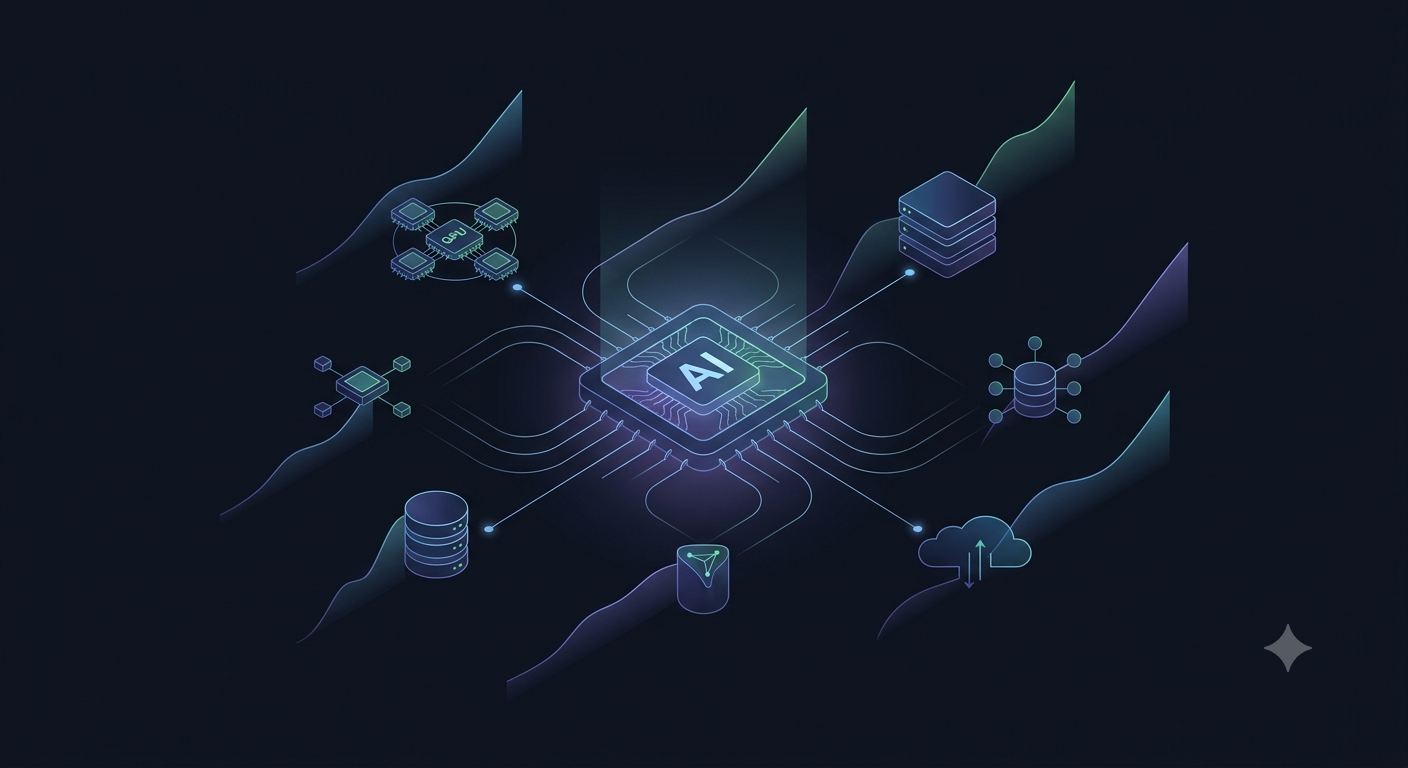
AI workloads create infrastructure around the model. Data needs to be collected, cleaned, stored, and processed. Embeddings need to be generated and updated. Vector databases need to store and serve those embeddings. Inference endpoints need to remain available, and development environments need resources for experimentation.
The model may be at the center of the workload.
But the infrastructure around it is where cloud consumption begins to spread.
This is different from how many traditional applications grow. A typical application has a relatively understandable relationship between demand and infrastructure. More users generally mean more compute, more database capacity, or more bandwidth. There are variations, but after operating these workloads for years, most organizations understand what drives their costs.
AI workloads don’t always behave that way.
A model may need to be retrained because the underlying data has changed. A new experiment may require another GPU environment. Embeddings may need to be regenerated across an entire dataset. An application with a relatively small number of users may still generate significant inference costs depending on how frequently the model is called and how much processing each request requires.
The relationship between usage and cost becomes less obvious.
And experimentation makes it even harder to predict.
We’ve seen AI initiatives start with a single proof of concept and gradually spread across the organization. One team experiments with semantic search. Another starts building an internal assistant. A third begins testing models for automation. Each project provisions what it needs, often independently of the others.
Again, none of these decisions are wrong.
But over time, organizations can end up with multiple models, datasets, vector stores, development environments, and pipelines operating across the cloud without a clear view of the combined cost.
That’s where the bill starts becoming difficult to understand.
Not because there is one expensive resource.
Because there are dozens of smaller ones supporting AI workloads across the organization.
One of the most common patterns we see is experimentation outliving the experiment itself. A notebook is created to test a model and continues running after the project pauses. A GPU cluster remains provisioned because the team plans to use it again. An inference endpoint stays active despite receiving very little traffic. A development dataset is retained long after the original experiment has changed direction.
These resources don’t always create dramatic spikes in spending.
They create something more difficult to notice.
Persistent cost.
A few hundred dollars here, a few thousand there. Over time, temporary infrastructure starts looking like permanent infrastructure, even though nobody intentionally decided to operate it that way.
This is why AI cost management can’t begin after a workload reaches production.
By that point, teams may already have established infrastructure patterns that are expensive to change. Cost visibility needs to exist while experimentation is happening, not just when the finance team starts asking questions about the monthly bill.
That doesn’t mean every AI experiment needs the same governance process as a production application. In fact, applying too much process can slow down the experimentation that makes AI valuable in the first place.
The better approach is to create lightweight financial guardrails.
Budgets can be assigned to experiments. GPU utilization can be monitored. Idle notebooks and development environments can be automatically shut down. Teams can be alerted when inference or data processing costs begin increasing beyond expected levels.
The important thing is giving teams visibility while they still have the ability to make changes.
We’ve found that this becomes particularly important because AI infrastructure often has multiple owners. The data team may manage the pipelines. Engineering may manage the application. Another team may be responsible for the model. Cloud costs, however, arrive as a single bill.
Without shared visibility, nobody sees the entire picture.
And when nobody sees the entire picture, optimization usually happens too late.
The organizations that manage AI costs effectively don’t treat AI as just another workload category. They recognize that it introduces a different consumption model and adjust their cloud strategy accordingly. They track utilization more closely, establish ownership earlier, and treat temporary experimentation resources as something that needs active management.
The goal isn’t to reduce AI spending at all costs.
AI is an investment, and meaningful workloads will require meaningful infrastructure.
The goal is to understand where that investment is going.
Because AI rarely becomes expensive overnight.
It becomes expensive gradually.
One experiment becomes a workload. One GPU becomes a cluster. One dataset becomes several copies moving through different pipelines. And before long, the organization isn’t paying for an AI experiment anymore.
It’s paying for an AI ecosystem.