Transcloud
July 16, 2026
July 16, 2026
Over the past few years, we’ve worked with organizations that have made significant investments in securing their cloud environments. Identity controls are strengthened, sensitive data is encrypted, network boundaries are carefully designed, and monitoring becomes part of everyday operations. From a technical standpoint, many of these environments are well built. Security isn’t an afterthought—it’s embedded into how the organization develops and operates its applications.
Then the audit begins.
One engagement in particular stands out. A customer was preparing for a security assessment as part of onboarding a large enterprise client. The engineering team wasn’t concerned because they knew the right controls were in place. Multi-factor authentication had been enforced, privileged access was tightly managed, and production workloads followed established security standards. They expected the assessment to confirm what they already believed—that their cloud environment was secure.
The conversation took a different direction almost immediately. The auditor wasn’t asking whether multi-factor authentication existed or whether encryption had been enabled. Instead, they wanted evidence that these controls had been consistently enforced over time. They asked for historical access records, policy evaluations, configuration changes, and proof that security controls had remained effective as the environment evolved. The questions weren’t about implementing security—they were about demonstrating it.
What followed wasn’t a security problem. It became an operational one.
The engineering team found themselves moving between cloud consoles, exporting audit logs, collecting screenshots, reviewing infrastructure changes, and piecing together evidence from multiple systems. None of the requested information was impossible to find, but it wasn’t readily available either. Information lived across different platforms, different teams, and different points in time. The environment was secure, yet proving it required far more effort than anyone had anticipated.
This is a pattern we’ve encountered repeatedly as cloud environments mature. Early on, security and compliance often feel like the same objective. Smaller teams know who changed what, infrastructure changes are relatively infrequent, and collecting evidence is usually manageable because the operational history still exists in people’s heads. Documentation is straightforward because there simply isn’t that much to document.
Growth changes that picture.
Cloud environments rarely stand still. New applications are deployed, infrastructure is rebuilt through automation, permissions are adjusted, and engineering teams expand. Every individual change is reasonable in isolation, but over months and years those changes accumulate into a level of operational complexity that is difficult to reconstruct manually. The challenge is no longer implementing security controls—it’s demonstrating that those controls have remained effective throughout continuous change.
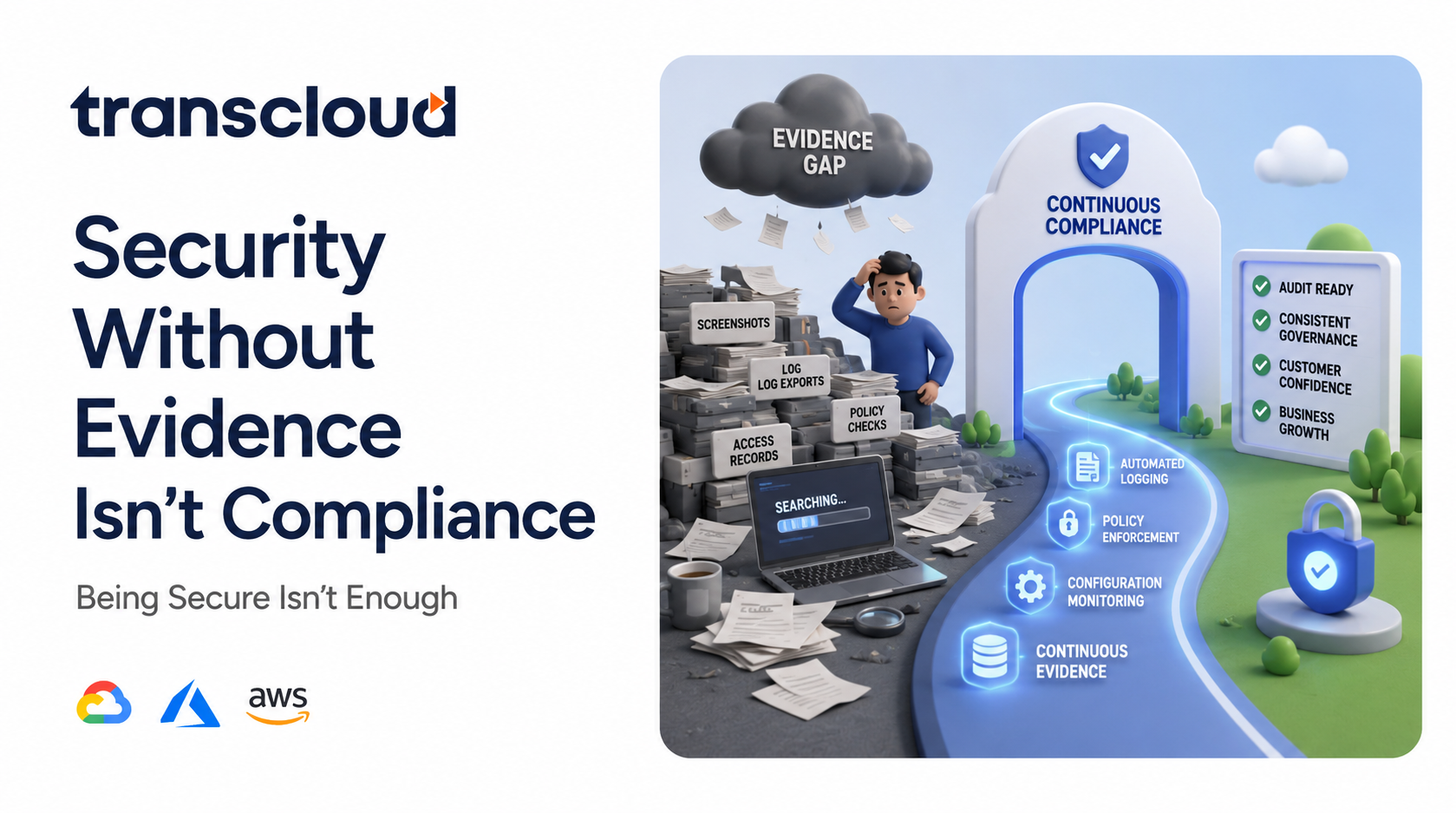
This is where many organizations encounter what we refer to as the evidence gap.
The evidence gap isn’t created because security controls are missing. More often, it appears because operational evidence hasn’t evolved at the same pace as the infrastructure itself. As organizations scale, audit logs, access records, configuration histories, policy evaluations, and infrastructure changes become distributed across multiple platforms. When evidence isn’t collected continuously, every audit becomes an exercise in reconstructing the past instead of validating the present.
The hidden cost isn’t failing the audit. It’s the amount of engineering effort required to prepare for one. We’ve seen highly skilled engineering teams spend days—sometimes weeks—gathering reports, validating configurations, and tracing historical changes simply to answer questions they already knew the answers to. Time that could have been spent improving products or supporting customers instead becomes dedicated to assembling documentation.
The organizations that navigate this well don’t necessarily invest in more security tools. Instead, they’ve changed the way they think about compliance. Rather than treating evidence collection as a project that begins when an auditor arrives, they make it part of their everyday operations. Infrastructure changes are automatically recorded, security policies are continuously evaluated, configuration drift is monitored, and compliance evidence is generated as systems evolve rather than months later.
This approach changes the nature of an audit. Instead of asking engineers to pause their work and reconstruct months of operational history, the required evidence already exists. Security reviews become validation exercises rather than large documentation projects, allowing engineering teams to remain focused on delivering value instead of searching for proof.
One lesson we’ve seen hold true across organizations is that security scales differently from compliance. Adding security controls as cloud environments grow is relatively straightforward. Building the operational processes that continuously demonstrate those controls is where many organizations struggle. The teams that stay ahead aren’t constantly preparing for audits—they’ve built environments where audit readiness is simply part of how they operate.
Because in modern cloud environments, being secure is only half the challenge.
Being able to prove it is what builds trust.