Transcloud
August 10, 2026
August 10, 2026
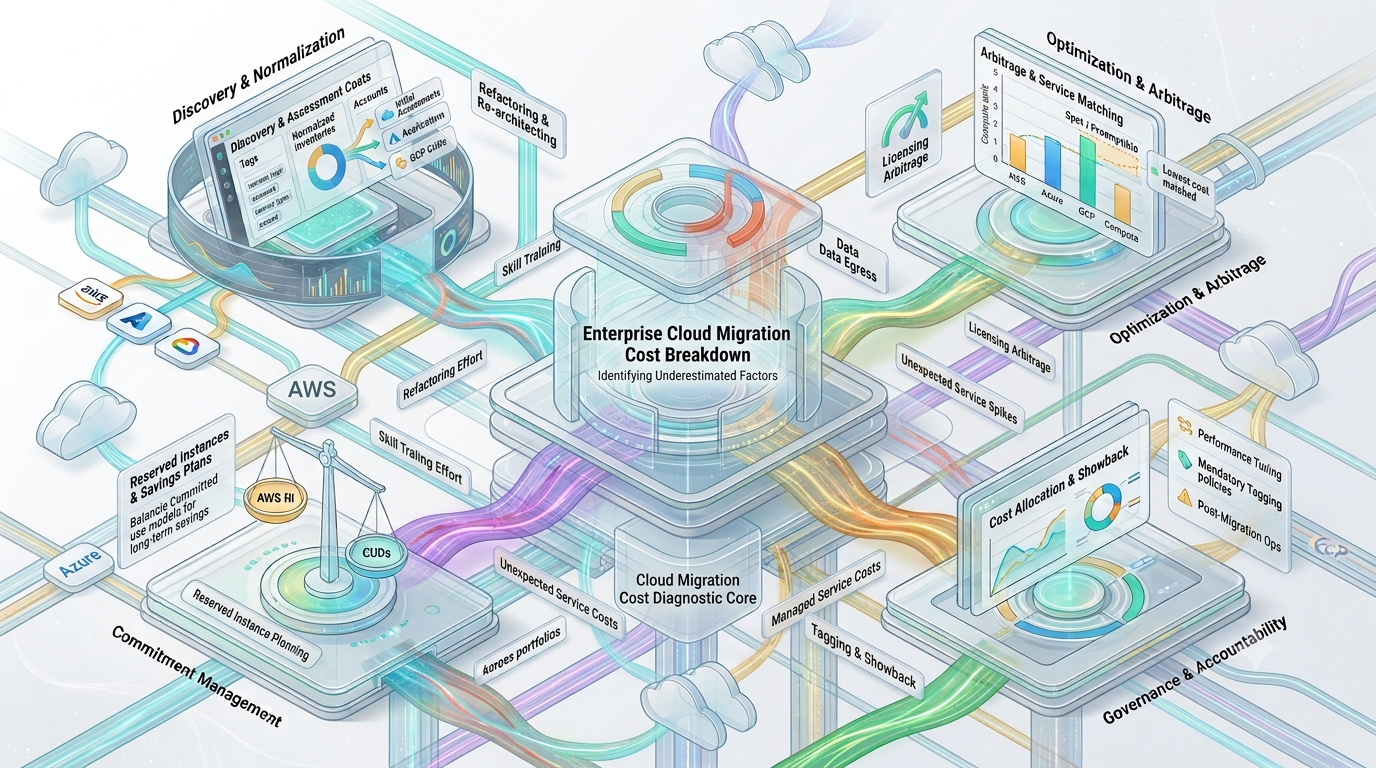
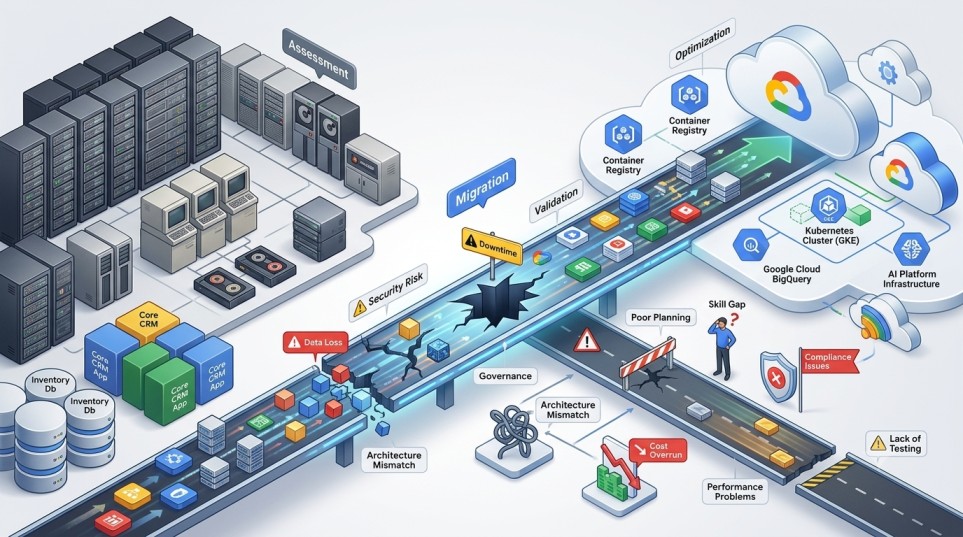
Cloud migration cost is consistently underestimated because enterprises focus on infrastructure pricing while ignoring hidden expenses such as data transfer, application refactoring, downtime risk, security reconfiguration, and post-migration optimization. The real cost of migrating to AWS, Azure, or GCP includes one-time migration effort plus long-term operational changes. In most enterprise cases, non-infrastructure costs can exceed direct cloud spend during the first 6–18 months.
Enterprises typically approach migration as an infrastructure replacement exercise. They compare on-premise costs to cloud pricing models from AWS, Azure, or GCP and assume savings will be immediate.
This assumption fails because cloud migration is not just a hosting change. It is a full transformation of:
Each of these layers introduces additional cost components that are not visible in simple pricing calculators.
Before migration begins, enterprises must understand their environment.
Most enterprises discover undocumented dependencies only during migration, leading to rework.
Not all workloads can be lifted and shifted.
Refactoring workloads for cloud-native architecture can cost significantly more than initial migration estimates.
Examples include:
One of the most underestimated cost categories.
Even after migration, poor architecture can lead to continuous cross-cloud traffic costs.
Security is not portable across environments.
Engineering time spent rebuilding security models is often not included in budgets.
Migration introduces operational risk.
Indirect business losses can exceed direct migration expenses in critical systems.
Enterprises rely on tools and external expertise.
During migration, many enterprises run both environments simultaneously.
Often 3–12 months depending on complexity.
Post-migration validation is not optional.
Engineering effort for iterative tuning across AWS, Azure, or GCP environments.
Once systems are live, optimization begins.
Organizations assume migration ends at “go-live,” leading to long-term inefficiencies.
Cloud migration requires skill transformation.
Without training, cloud adoption becomes inefficient and costly.
| Cost Category | Direct vs Indirect | Impact Level |
| Infrastructure pricing | Direct | Medium |
| Data migration | Direct | High |
| Architecture redesign | Indirect | Very High |
| Security setup | Indirect | High |
| Downtime risk | Indirect | Critical |
| Tooling | Direct | Medium |
| Dual running costs | Direct | High |
| Training & change | Indirect | High |
| Optimization phase | Indirect | High |
Ignoring network, storage, and operational costs.
Assuming all applications can be lifted and shifted.
Running old and new systems simultaneously increases spend.
No FinOps model leads to sustained inefficiencies.
Leads to migration failures and rework.
Avoid large-scale “big bang” migrations.
Separate:
Cost governance must start before migration.
Reduce cross-region and cross-cloud traffic.
Reuse migration blueprints across workloads.
Because enterprises underestimate non-infrastructure costs such as redesign, security, and downtime risk.
Architecture redesign and dual running environments are often the largest cost drivers.
Initially yes, but it often leads to higher long-term operational costs.
Typically 6–18 months depending on complexity and workload size.
Yes, through phased migration, FinOps adoption, and standardized architecture patterns.
Cloud migration cost is fundamentally a transformation cost, not a hosting cost. AWS, Azure, and GCP pricing models only represent a fraction of the total financial impact.
Enterprises that fail to account for architecture redesign, security rework, dual-running systems, and operational changes consistently underestimate total investment requirements.
A structured cost model combined with workload-based planning and FinOps governance is essential for predictable and controlled migration outcomes.