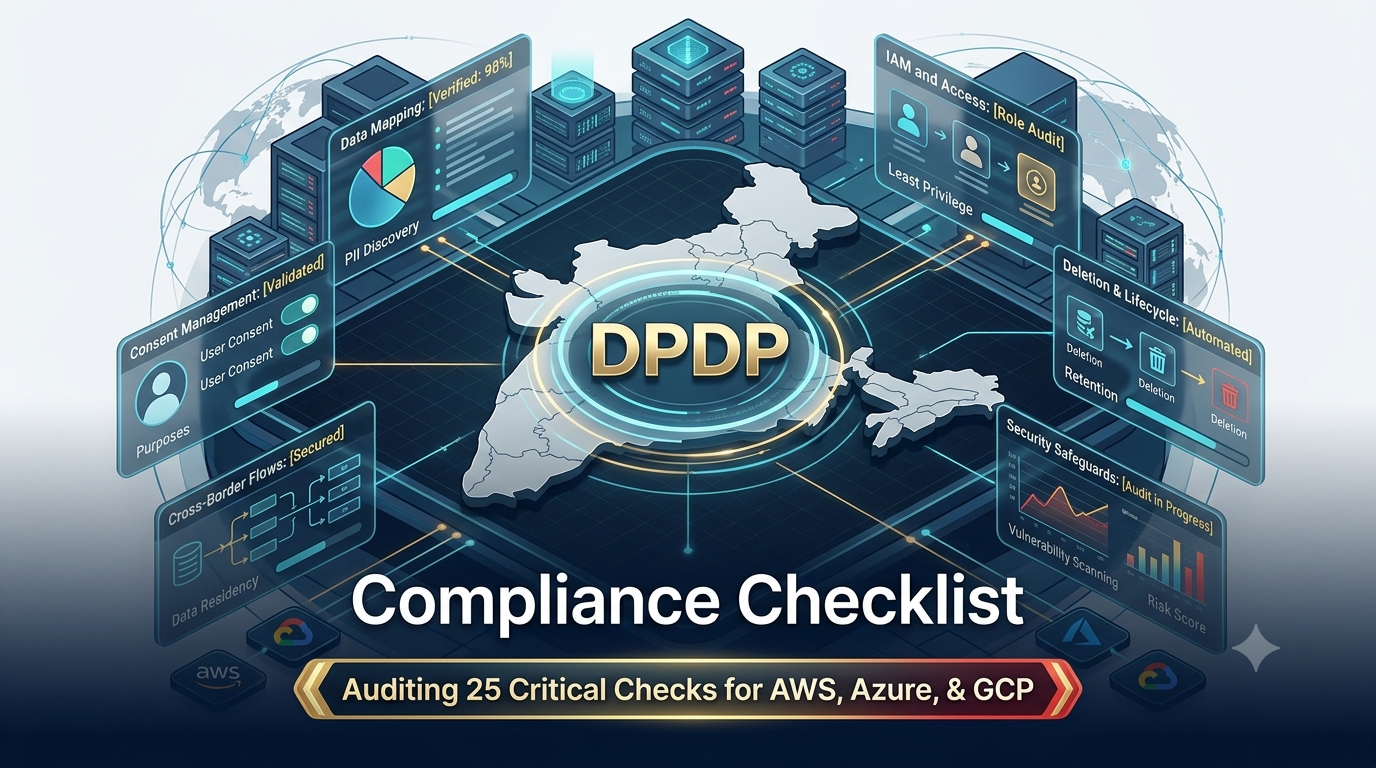
Is Your Cloud Infrastructure Compliant with India’s DPDP Act? A Practical Checklist for Enterprises
Transcloud
August 5, 2026
Quick Answer
DPDP Act compliance in cloud environments (AWS, Azure, and GCP) is primarily an infrastructure governance problem, not just a legal or policy issue. Enterprises must ensure controlled data collection, strict access governance, encryption, audit logging, retention enforcement, and cross-border transfer visibility. Most compliance failures occur due to poor data discovery, over-permissioned IAM, unmanaged shadow data, and lack of end-to-end audit trails.
Key Takeaways
DPDP compliance is enforced through cloud configuration and data governance controls.
IAM misconfiguration and shadow data are the biggest enterprise risks.
Encryption, logging, and retention policies are mandatory technical baselines.
Cross-border data flows must be explicitly tracked in multi-cloud setups.
Compliance cannot be achieved with policies alone; it requires continuous monitoring.
AWS, Azure, and GCP each provide partial tools; unified governance is required.
Why DPDP Changes Cloud Infrastructure Design
The Digital Personal Data Protection (DPDP) Act, 2023 applies to any organization processing personal data of Indian users, including SaaS platforms, enterprises, and cloud-hosted workloads. It applies even when data is stored or processed outside India if services are offered to Indian users.
In cloud environments, this translates into operational requirements across:
Data storage (where personal data resides)
Identity and access (who can access it)
Processing pipelines (how data is used)
Third-party integrations (where data flows externally)
Auditability (how actions are tracked and proven)
Most organizations fail not at intent, but at infrastructure visibility.
1. Data Discovery and Inventory Control
What must be checked
All personal data sources across AWS, Azure, and GCP
SaaS integrations (CRM, analytics, support tools)
Shadow data in developer environments and local systems
If data cannot be mapped, it cannot be governed under DPDP.
2. Consent and Purpose Enforcement Layer
What must be checked
Data collection tied to explicit purpose
No secondary use without consent tracking
Consent records stored and retrievable
Cloud implementation
API gateway-level consent validation
Event-driven logging of consent state
Centralized consent store (cross-cloud)
Failure mode
Data is collected once and reused across systems without tracking original purpose.
3. IAM and Access Governance
What must be checked
Least privilege access across all cloud identities
Service accounts reviewed and rotated
No persistent admin-level access by default
Critical risk
Over-privileged roles expose entire datasets in case of compromise.
Controls
AWS IAM Access Analyzer
Azure AD Privileged Identity Management
GCP IAM Recommender
IAM drift is one of the most common DPDP violations in enterprise environments.
4. Encryption and Key Management
What must be checked
Encryption at rest enabled for all storage systems
TLS enforced for all data in transit
Centralized key management and rotation policies
Tools
AWS KMS / CloudHSM
Azure Key Vault
GCP Cloud KMS
Failure mode
Encrypted storage without proper key governance still results in compliance gaps.
5. Audit Logging and Traceability
What must be checked
Every access to personal data is logged
Logs are tamper-resistant and retained
Cross-cloud logging aggregation exists
Controls
AWS CloudTrail
Azure Monitor + Sentinel
GCP Cloud Audit Logs
Without logs, DPDP breach reporting obligations cannot be met within required timelines.
6. Data Retention and Deletion Enforcement
What must be checked
Defined retention policies per data category
Automated deletion workflows
Backup systems also reflect deletion rules
Common failure
Data deleted in production remains in backups or analytics pipelines.
Required control
Lifecycle policies must extend across all storage layers.
7. Cross-Border Data Transfer Visibility
What must be checked
All external data flows mapped
Region-level storage awareness
Third-party SaaS integrations tracked
Risk area
Multi-cloud architectures often move data across regions unintentionally.
Control approach
Network flow logging
API gateway monitoring
Data lineage tracking systems
8. Security Baseline Configuration (Multi-Cloud)
What must be checked
Public access to storage buckets disabled
Firewall rules restricted
Default configurations hardened
Tools
AWS Security Hub
Azure Security Center (Defender for Cloud)
GCP Security Command Center
Misconfigurations remain the leading cause of cloud exposure incidents.
9. Data Principal Rights Enablement
What must be checked
Ability to retrieve user data on request
Data correction workflows exist
Deletion requests propagate across systems
Operational requirement
Requests must be fulfilled within defined timelines (typically 30 days under DPDP framework interpretation).
10. Vendor and Third-Party Governance
What must be checked
DPDP-compliant contracts with all processors
Access scope limitations for vendors
Continuous monitoring of third-party integrations
Common issue
External SaaS tools hold copies of personal data outside enterprise control.
11. Monitoring and Continuous Compliance
What must be checked
Real-time anomaly detection
Automated compliance drift detection
Central dashboards across AWS, Azure, and GCP
Failure mode
Compliance checked once during audits, not continuously enforced.
12. Breach Readiness and Incident Response
What must be checked
Defined breach classification system
Automated alerting for sensitive data access
Incident response workflows tested
Requirement impact
DPDP mandates structured breach reporting within defined timelines, making detection speed critical.
Cloud Compliance Maturity Model
Level
Description
DPDP Readiness
Level 1
Manual policies
Low
Level 2
Basic cloud security tools
Moderate
Level 3
Centralized governance
Good
Level 4
Automated compliance enforcement
Strong
Level 5
Continuous real-time compliance
Enterprise-grade
Common DPDP Compliance Gaps in Enterprises
Data scattered across multiple SaaS tools
Over-permissioned IAM roles
Missing cross-cloud visibility
No retention enforcement in backups
Weak vendor governance
Lack of real-time monitoring
Practical Enterprise Implementation Approach
Step 1: Map all personal data sources
Across cloud, SaaS, and internal systems.
Step 2: Enforce IAM least privilege
Remove default admin-level access.
Step 3: Centralize logging and monitoring
Unify AWS, Azure, and GCP telemetry.
Step 4: Implement retention automation
Apply lifecycle policies across storage systems.
Step 5: Establish data governance ownership
Assign accountability across security, IT, and compliance teams.
Frequently Asked Questions
Does DPDP apply to cloud providers like AWS and Azure?
Yes, they act as data processors, but enterprises remain responsible as data fiduciaries.
Is encryption enough for DPDP compliance?
No, encryption is necessary but not sufficient. Access control and governance are also required.
Do small companies need to comply?
Yes, DPDP applies to any organization processing personal data of Indian users.
Is multi-cloud more risky for DPDP compliance?
Yes, due to fragmented visibility and inconsistent governance.
Final Thoughts
DPDP compliance is fundamentally a cloud architecture problem disguised as a legal requirement. Enterprises that rely on policy documents without enforcing technical controls will struggle to achieve real compliance.
A structured approach across IAM, data governance, logging, encryption, and retention is required to operationalize DPDP in AWS, Azure, and GCP environments.
Organizations that treat compliance as continuous infrastructure engineering rather than periodic audits achieve significantly lower risk exposure and better governance maturity.
Stay Updated with Latest Blogs
You May Also Like
Kubernetes Scaling Achieved Through Expert Managed Services
We use cookies to ensure that we give you the best experience on our website. If you continue to use this site we will assume that you are happy with it.Ok