
Transcloud
January 6, 2026
January 6, 2026
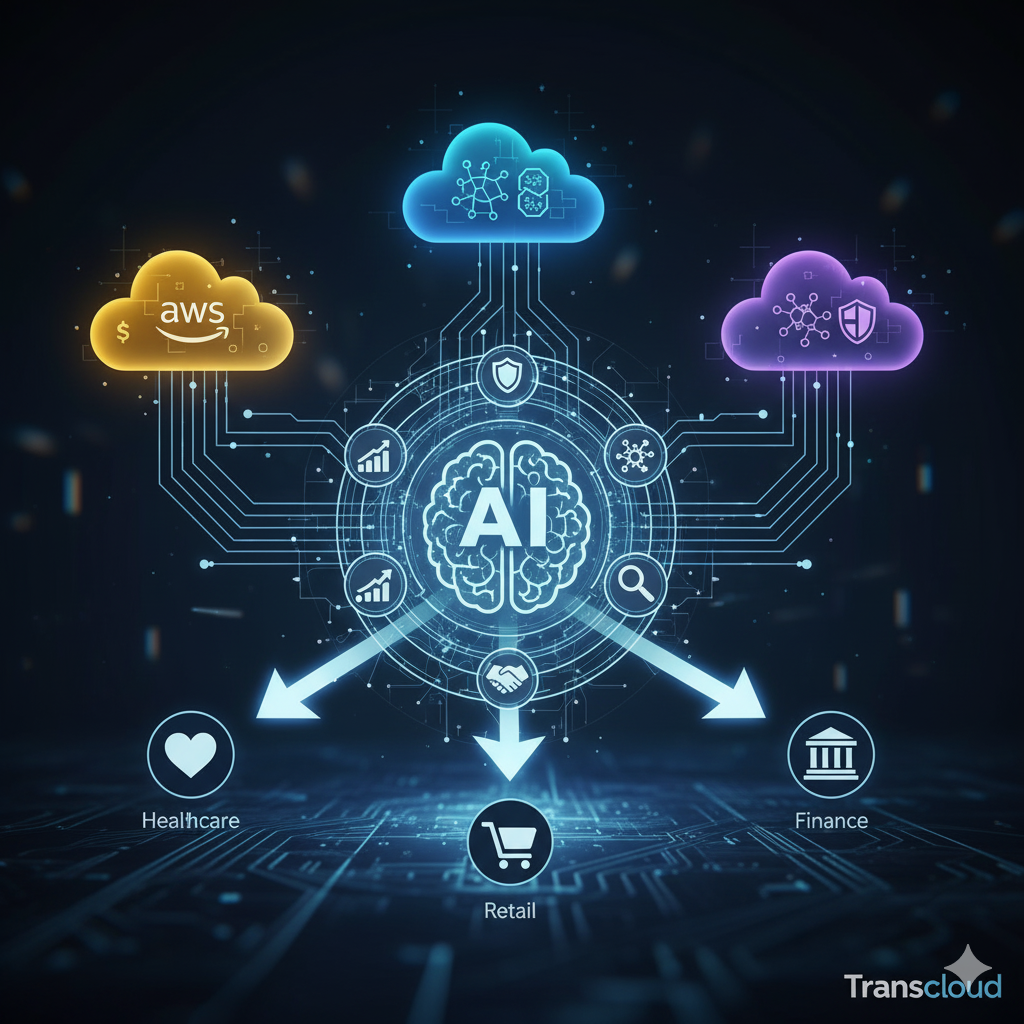
Artificial Intelligence (AI) has moved from being an experimental technology to a mission-critical driver of digital transformation with AI. At the same time, enterprises are no longer locked into a single provider. Instead, they are increasingly embracing multi-cloud strategies for AI and ML applications to harness specialized capabilities, manage risks, and optimize costs.
Transcloud, a leading partner in cloud technology solutions, has observed that the combination of multi-cloud AI solutions and cloud machine learning creates a powerful synergy. Enterprises can leverage best-in-class cloud AI services across providers while ensuring resilience, compliance, and scalability. This marks a new chapter in AI-powered business solutions — where enterprises are reimagining how they build, deploy, and scale intelligent systems with expert guidance from providers like Transcloud.
Across industries, enterprise AI solutions are accelerating adoption. From predictive analytics in manufacturing to AI-powered business solutions for personalized retail experiences, enterprises are embedding machine learning (ML), deep learning, and neural networks into daily operations.
Gartner estimates that by the end of this decade, over 80% of enterprises will have AI-driven business transformation initiatives. However, as AI model training in cloud and natural language processing (NLP) workloads grow in complexity, a single-cloud AI deployment is no longer sufficient.
While leading platforms like AWS AI/ML, Google Cloud AI/ML, and Azure Machine Learning offer rich cloud-native AI/ML platforms, no single provider delivers everything enterprises need.
Enterprises are moving toward multi-cloud AI architecture, selecting the managed AI services across cloud providers that best fit each workload — with guidance from cloud specialists like Transcloud.
Adopting multi-cloud AI solutions is not just a trend — it’s a strategic shift.
Each cloud offers unique strengths:
A multi-cloud strategy for AI and ML applications lets enterprises combine these strengths into one holistic ecosystem.
AI workloads are compute-intensive. Large-scale AI model training in cloud may be cheaper on one provider, while real-time NLP inference could run faster on another. Cloud machine learning across vendors allows enterprises to optimize performance and cost simultaneously.
By diversifying, enterprises mitigate risks of downtime or vendor-specific outages. In mission-critical enterprise AI solutions, availability is non-negotiable.
Competition among cloud providers empowers multi-cloud cost optimization. Enterprises running AI in the cloud avoid lock-in and align spend with performance.
Beyond efficiency, multi-cloud AI solutions deliver strategic benefits that shape competitiveness.
Industries like finance and healthcare must comply with sovereignty regulations. AI/ML cloud migration enables storage within borders while supporting edge AI deployments for faster insights.
Security is a priority in AI strategy for enterprises. A multi-cloud AI architecture enables layered AI governance and risk management, reducing single points of failure.
Leveraging cloud AI services across providers accelerates innovation. Multi-cloud CI/CD pipelines streamline secure AI deployment in cloud, reducing time-to-market.
Adopting multi-cloud AI solutions requires more than vendor contracts. Enterprises must focus on:
The convergence of multi-cloud strategy for AI and ML applications is setting the stage for the next era of intelligence.
By avoiding lock-in, enterprises ensure adaptability to future technologies — from generative AI to quantum-ready AI in the cloud.
The rise of multi-cloud AI solutions is not hype — it’s a necessity. Enterprises gain:
Transcloud help organizations adopt these strategies, ensuring AI-powered business solutions are scalable, compliant, and future-ready.
Start with hybrid or dual-cloud pilots. Scale gradually into a multi-cloud AI architecture as governance matures.