Transcloud
April 22, 2026
April 22, 2026
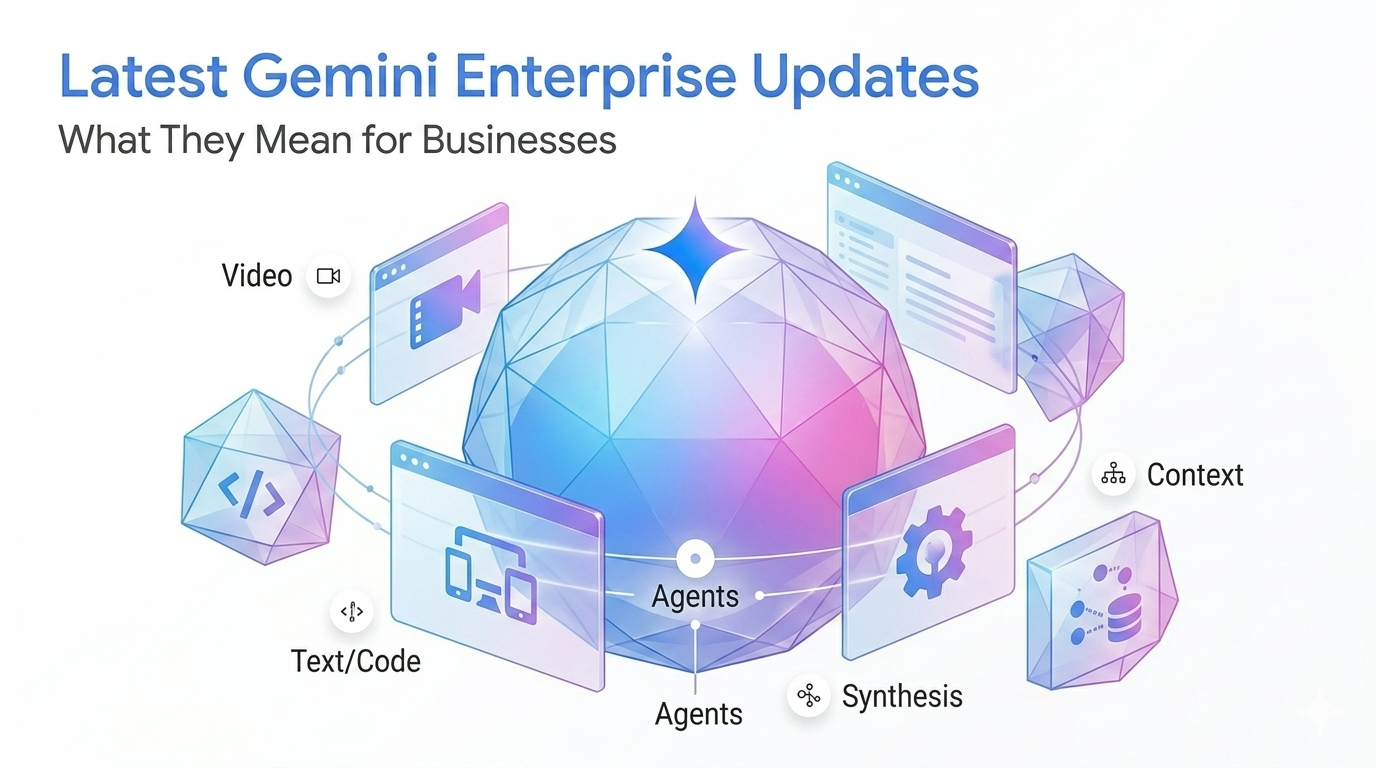
In the rapidly evolving world of generative AI, updates to major platforms like Gemini Enterprise are business-critical signals. Every improvement in capability, integration, or governance can directly affect efficiency, security, and the return organizations see from their AI investments. In this article, we look at the most recent developments related to Google’s Gemini Enterprise, explain what they mean in practical business terms, and suggest how companies can respond to stay ahead.
This isn’t a technical product changelog. Instead, it is a business-oriented perspective on how recent changes influence strategic adoption, organizational processes, and AI value realization.
Over the past year, Gemini Enterprise has undergone a series of updates that shift its positioning from “powered AI assistant” to a more integrated, enterprise-ready intelligence platform. While the cadence of updates continues, the major themes companies should focus on include:
1. Expanded Model Capabilities
Gemini Enterprise’s underlying models have gained improvements in reasoning, contextual understanding, and multimodal outputs. This translates into more accurate, useful results in knowledge work scenarios commonly seen in business operations.
2. Enhanced Security and Governance Controls
New administrative tools allow IT and security teams to define usage policies, manage access levels, and audit activity more effectively. These features are essential for organizations with compliance requirements.
3. Deeper Integration with Enterprise Systems
Recent updates have strengthened Gemini’s ability to connect with internal data sources, collaboration tools, and workflow platforms. This aligns with broader enterprise goals of embedding AI into existing processes rather than treating it as a separate silo.
4. New Productivity and Collaboration Features
Functionality aimed at teams—such as shared contexts, templated workflows, and collaboration modes—reflects a focus on not just individual productivity, but team productivity and alignment.
5. Pricing and Licensing Clarity
With clearer guidance on enterprise pricing tiers and usage models, organizations can plan budgets more accurately. This includes insights into how usage volume, team roles, and integration needs influence costs.
Each of these areas has implications for businesses evaluating or already using Gemini Enterprise.
When an AI model’s reasoning and contextual understanding improve, the impact is felt directly in end-user productivity. Rather than generic responses, employees can get outputs that reflect deeper comprehension of business language, document nuances, and multi-step tasks.
For example:
In practical terms, this means less human correction and more dependable AI outputs. For organizations, that translates into time savings and higher confidence in AI-assisted work.
One of the biggest barriers to enterprise AI adoption is risk. Many companies hesitated to adopt public AI tools because of concerns over data exposure, lack of oversight, and insufficient control mechanisms.
With expanded governance features, IT teams can now:
This is especially important for regulated industries such as finance, healthcare, and legal services, where compliance is not optional. These controls allow organizations to adopt AI without exposing sensitive information or violating internal policies.
From a business perspective, governance features are not nice-to-have—they are risk mitigators that make enterprise AI feasible for larger, more cautious organizations.
The ability to connect Gemini Enterprise with enterprise systems and internal data is one of the most transformative updates for business value. Search, analysis, and AI-driven recommendations become far more useful when tools can access relevant corporate data rather than only public or user-provided text.
Recent enhancements in integration include:
This change moves AI from being a standalone assistant to an embedded knowledge layer. Companies can start to see AI outputs that reflect internal context and information, making AI much more useful in daily workflows.
From a business perspective, this means that AI becomes part of the enterprise data ecosystem rather than an external add-on.
With features focused on teams rather than just individuals, organizations get more than isolated answers. Business workflows benefit when AI can support group processes such as drafting reports collaboratively, aligning on shared contexts, and reusing templates.
Examples of team-oriented improvements include:
For businesses, this has two key effects:
In essence, these updates help spread AI value beyond individual productivity to collective productivity gains.
Predictability in pricing is another important development. Enterprise buyers often struggle with uncertainty—pricing based only on headcount or usage estimates makes budgeting difficult.
With clearer pricing models:
This clarity supports responsible adoption and addresses a common blocker in enterprise procurement.
From a competitive standpoint, companies adopting these updated enterprise AI capabilities gain tactical advantages:
Strategic implications include:
In other words, organizations that integrate enterprise AI thoughtfully are positioning themselves for long-term operational efficiency and agility.
Given these updates, how should organizations respond?
1. Reevaluate your AI strategy
If you paused adoption earlier due to risk or cost concerns, the expanded governance and pricing clarity make it worth revisiting.
2. Identify high-impact use cases
Look for knowledge-intensive areas or processes that are repetitive and rely on internal data—these are strong early candidates.
3. Start with pilots and measure outcomes
Teams that pilot tools in controlled environments tend to show clearer value and build internal momentum.
4. Build governance frameworks before full rollout
Create policies, monitoring procedures, and approval processes early so adoption is structured, not chaotic.
5. Align AI adoption with broader digital strategy
Enterprise AI should not sit in a silo. Connect it with business goals, performance metrics, and long-term transformation plans.
The latest updates to Gemini Enterprise reflect a shift from experimentation to enterprise readiness. They strengthen the case for adoption in organizations that value security, governance, integration, and measurable impact.
From expanded model capabilities to enhanced governance and pricing clarity, these changes reduce barriers that previously slowed enterprise AI adoption. The companies that gain real value are the ones that pair these capabilities with disciplined planning, clear governance, and alignment to business outcomes.
Enterprise AI is not a trend. It is becoming a core part of how modern businesses operate. The key is not simply using tools but integrating them into workflows in ways that drive measurable value.