
Transcloud
June 5, 2026
June 5, 2026
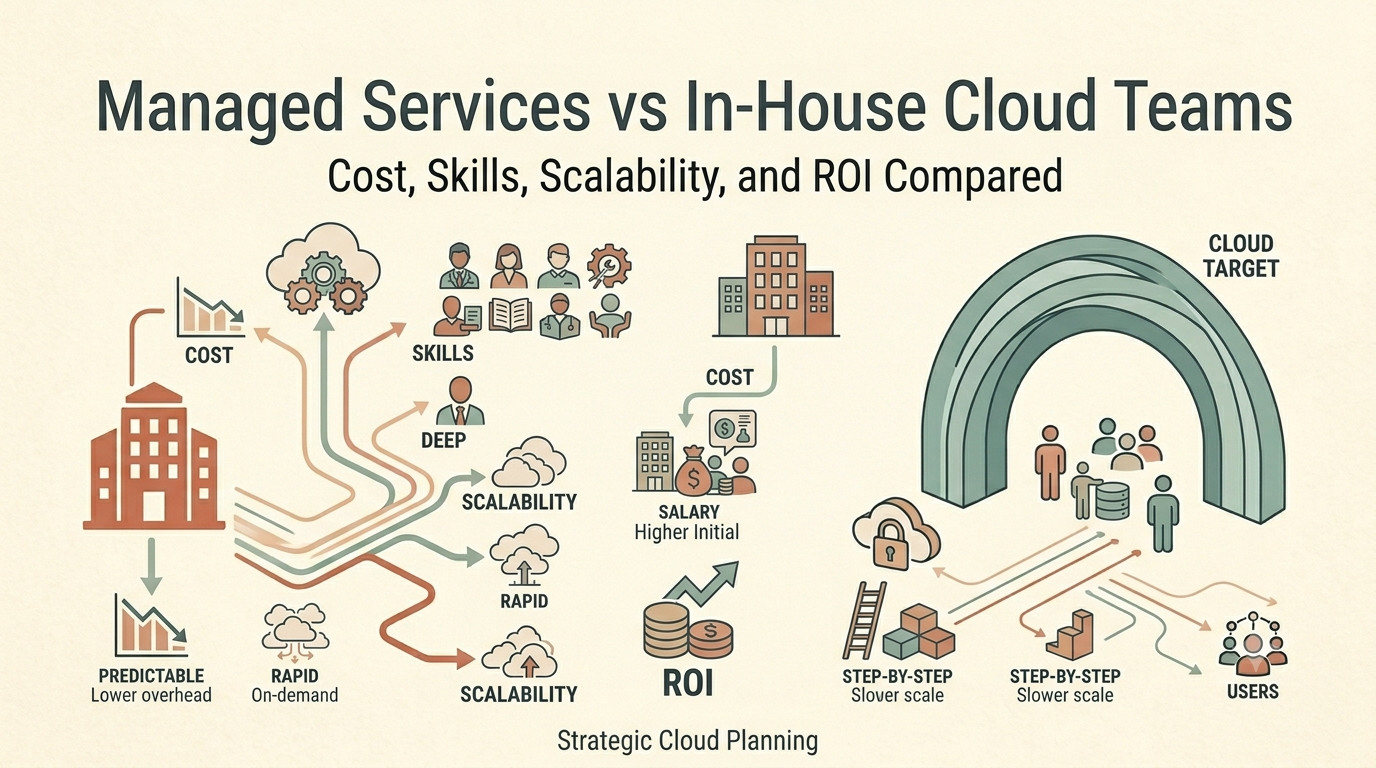
Choosing between managed cloud services and building an in-house cloud team depends on your organization’s scale, maturity, and strategic priorities. Managed services provide external expertise, operational efficiency, and faster scalability, while in-house teams offer greater control, customization, and long-term capability building. Most enterprises today adopt a hybrid model where core platform ownership remains internal, while operational tasks are partially or fully outsourced.
Cloud adoption has moved beyond infrastructure migration. Enterprises now operate complex multi-cloud environments across AWS, Azure, and Google Cloud Platform (GCP), managing workloads that span analytics, AI, security, and global applications.
As complexity increases, organizations face a key operational question:
Should cloud operations be managed internally, or should they be outsourced to a specialized provider? This decision directly impacts cost efficiency, security posture, scalability, and speed of innovation.
Managed cloud services involve outsourcing cloud operations to a third-party provider. These providers handle infrastructure monitoring, security management, cost optimization, patching, incident response, and sometimes full platform operations.
Typical responsibilities include:
The goal is to allow internal teams to focus on product development and business strategy rather than infrastructure maintenance.
An in-house cloud team is an internal group of engineers responsible for designing, building, and operating cloud infrastructure.
Typical roles include:
This team builds internal capabilities and maintains full control over cloud environments.
Cost is often the primary factor in this decision, but the comparison is not straightforward.
Managed services typically involve:
Costs are predictable and scale with consumption.
In-house teams involve:
Managed services often appear more expensive per unit of labor, but reduce hidden costs such as downtime, inefficiencies, and under-optimized infrastructure. In-house teams can become cost-effective at scale, but only when fully optimized and well-staffed.
Managed service providers typically bring:
This reduces the learning curve for organizations adopting cloud at scale.
Building internal expertise requires:
Skill shortages in cloud-native technologies remain a common challenge globally.
Managed services scale more easily because:
This makes them ideal for:
In-house scalability depends on:
Scaling internal teams often lags behind infrastructure growth.
Highly regulated industries often prefer in-house or hybrid models for this reason.
Return on investment differs based on maturity level.
Higher ROI in:
ROI drivers include reduced downtime, faster deployment, and optimized resource usage.
Higher ROI in:
ROI comes from long-term capability building and reduced vendor dependency.
Managed services are typically the right choice when:
In-house teams are preferable when:
Most enterprises do not choose one model exclusively.
Instead, they adopt a hybrid approach:
This model balances control with efficiency.
Short-term savings often hide long-term inefficiencies.
Cloud operations require deep, specialized expertise.
Multi-cloud environments significantly increase management overhead.
Unclear responsibility models lead to delays and incidents.
A structured approach helps clarify the decision:
Not always. Managed services reduce hidden operational costs, while in-house teams may become more cost-efficient at scale.
Yes. Hybrid operating models are now the most common approach.
Managed services are usually better for early-stage startups due to speed and cost efficiency.
Both can be secure if properly implemented. In-house teams offer more direct control, while managed services bring standardized security practices.
Yes, most modern providers specialize in AWS, Azure, and GCP environments.
The decision between managed services and in-house cloud teams is not binary.
It is a spectrum of control, cost, scalability, and operational maturity.
Organizations that are early in their cloud journey benefit from managed services due to speed and expertise. As they mature, they often transition toward in-house capabilities while retaining selective managed support.
The most effective cloud operating model is the one that aligns with business priorities rather than organizational preference.
For most enterprises, a hybrid operating model delivers the best balance between efficiency and control.