Transcloud
May 8, 2026
May 8, 2026
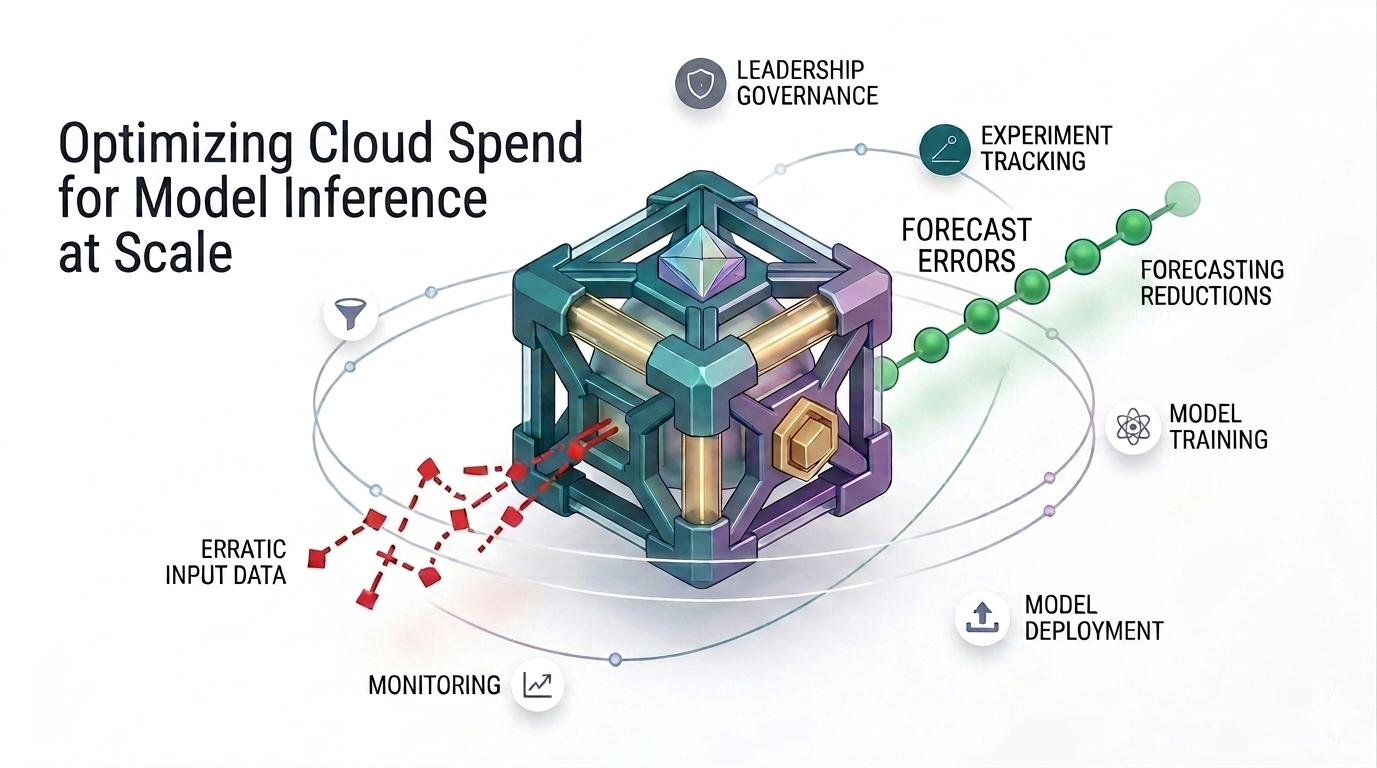
As machine learning moves from research to production, model inference becomes the primary driver of cloud costs. While training can be scheduled and controlled, inference workloads are often continuous, real-time, and user-facing, which makes them harder to optimize. In enterprise deployments, inference costs can surpass training spend, especially for high-volume applications like recommendation engines, fraud detection, or predictive analytics. Without deliberate optimization, scaling inference pipelines across AWS, GCP, and Azure can quickly lead to budget overruns.
Inference cost isn’t just about compute; it encompasses several often-overlooked factors:
According to a 2024 O’Reilly survey, inference workloads account for up to 40% of total ML cloud expenditure in high-scale enterprise deployments. Ignoring efficiency at this stage undermines the ROI of the AI initiatives.
Scaling model inference cost-effectively requires a combination of infrastructure, pipeline, and MLOps best practices:
Leveraging cloud-native autoscaling features ensures that inference instances scale in response to demand. AWS SageMaker endpoints, GCP Vertex AI prediction nodes, and Azure ML real-time endpoints all support dynamic allocation. Proper configuration reduces idle compute costs while maintaining performance during spikes.
Techniques like pruning, quantization, and mixed-precision inference can reduce GPU/CPU consumption without significant accuracy loss. Smaller models not only run faster but also consume fewer resources, directly impacting cost efficiency.
Batching requests, when feasible, allows multiple inferences to share a single compute cycle, significantly reducing per-inference cost. Scheduling batch jobs during off-peak hours further optimizes utilization, especially for pipelines that can tolerate slight delays.
For latency-sensitive applications, deploying models on edge devices reduces cloud load and egress costs. Hybrid deployments can balance cost and performance by combining local inference for frequent queries with cloud-based models for complex predictions.
Tracking inference metrics is essential. Monitoring GPU utilization, response latency, and resource allocation allows teams to identify inefficiencies. Platforms like Kubeflow, MLflow, and Vertex Pipelines integrate resource observability, helping prevent budget overruns while maintaining service quality.
Optimizing inference is a trade-off between latency, throughput, and cost. Enterprises that adopt these strategies consistently achieve:
These improvements do not compromise model accuracy or responsiveness but ensure that ML deployments are financially sustainable at scale.
Effective MLOps practices amplify inference cost efficiency:
MLOps transforms inference from a hidden expense into a predictable, controllable component of AI operations.
Model inference is where AI meets the real world — user-facing predictions, automated decisions, and business-critical insights. Without careful cost management, scaling inference pipelines can quickly erode the value of even the most accurate models. By combining cloud-native autoscaling, model optimization, batch processing, and robust MLOps observability, enterprises can scale ML inference efficiently, maintain accuracy, and preserve budget predictability. Cost-effective inference is no longer a technical nicety; it is a strategic imperative for enterprise AI.