
Transcloud
May 4, 2026
May 4, 2026
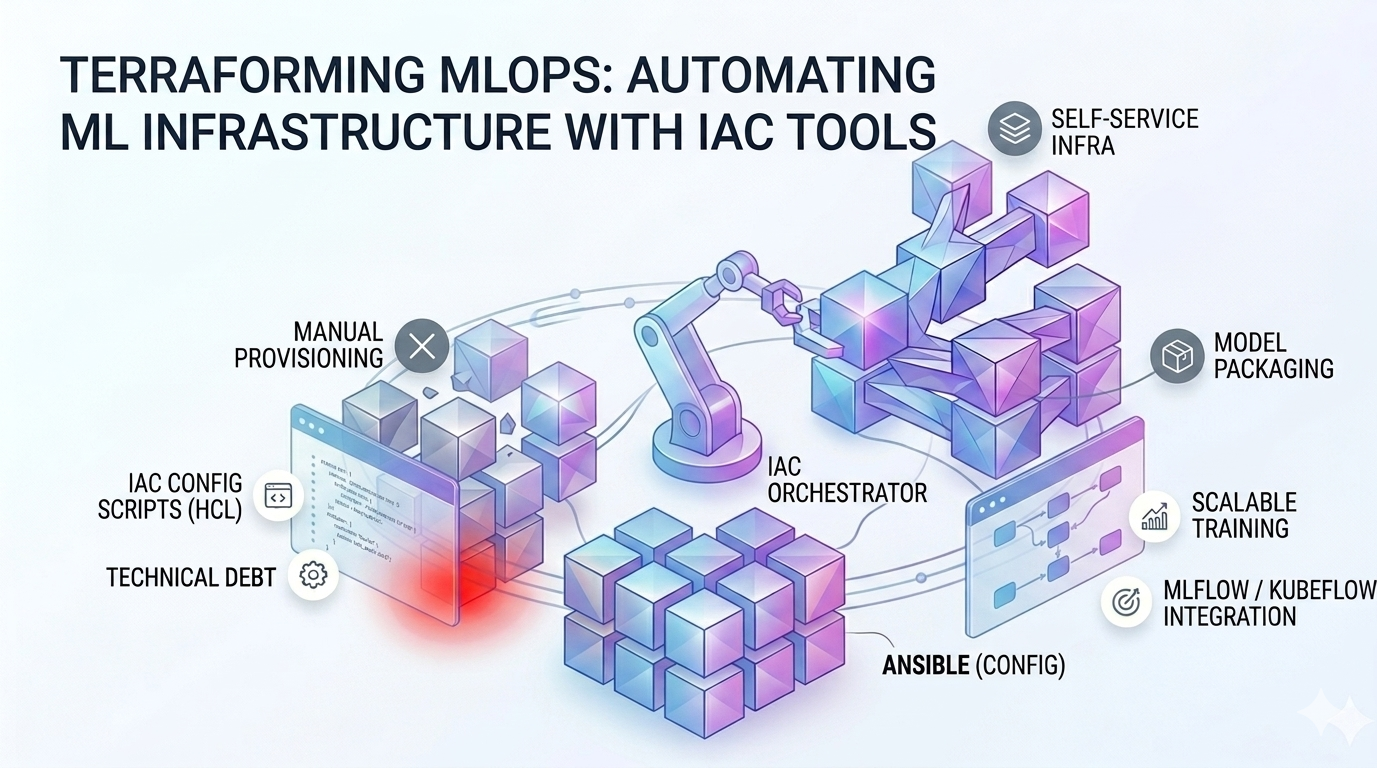
Machine learning systems evolve faster than the infrastructure that supports them. Models scale, data volumes spike, training patterns change, and GPU requirements shift from week to week. What begins as a simple experimentation environment quickly becomes an operational burden across clouds, teams, and environments. This is why Infrastructure as Code (IaC) — and Terraform in particular — has become a foundational pillar of enterprise-grade MLOps.
Where traditional DevOps uses IaC to standardize build and deployment workflows, MLOps uses IaC to tame the inherently volatile nature of ML workloads. Terraform’s role in this context isn’t merely provisioning virtual machines or storage. It enables reproducibility, governance, and operational discipline for ML systems that are constantly regenerating themselves.
In machine learning, infrastructure is not a static backend — it is part of the model lifecycle. Training jobs need elastic compute. Feature stores need consistent I/O patterns. Pipelines require secure networking. Deployment endpoints scale unevenly depending on inference loads. Without codified infrastructure, every one of these components becomes a snowflake environment that breaks reproducibility and slows delivery.
Terraform brings structure to what is otherwise chaos:
Taken together, Terraform doesn’t just automate infrastructure — it stabilizes the ML lifecycle.
A common anti-pattern in ML is spinning up “temporary” GPU instances, R&D clusters, or custom data environments that eventually morph into production dependencies. Terraform converts these one-off creations into structured, versioned environments that can be rebuilt, audited, and retired cleanly.
This eliminates the “it works only on this cluster” problem — a recurring failure point for ML teams.
For ML organizations with multiple data science squads, consistency is a challenge. Different teams use different tools, environments, and conventions. Terraform creates a unified ML platform by standardizing:
This standardization accelerates onboarding, reduces operational friction, and prevents fragmented ML infrastructure.
Enterprises operating with sensitive data — finance, healthcare, telecom, logistics — face stringent governance requirements.
Terraform’s declarative model ensures that:
This eliminates undocumented cloud configurations and ensures every model operates under the same compliance guarantees without requiring manual enforcement.
Machine learning deployments are fragile — model updates, real-time inference surges, or large batch-training cycles often stress infrastructure in unpredictable ways. Terraform mitigates these challenges by:
The result is ML infrastructure that behaves like a mature, production-grade system — not a research playground.
Instead of using Terraform as a provisioning script, mature ML organizations treat it as a backbone that integrates with the entire MLOps ecosystem:
By defining these as code, the ML platform becomes:
This is crucial for enterprises seeking hybrid or multi-cloud ML strategies.
Enterprise ML environments benefit the most from Terraform when infrastructure is designed as modular, composable building blocks rather than monolithic scripts. ML stacks evolve rapidly — a new model type might require a different accelerator or storage pattern — and modular IaC enables this evolution without destabilizing the entire environment.
Another pillar of best practice is enforcing consistent lifecycle separation between development, staging, and production ML environments. Each has distinct compute patterns, access needs, and compliance requirements. Treating these environments as individual Terraform states ensures isolation and prevents accidental cross-environment drift — a surprisingly common source of ML outages.
Integration with CI/CD systems is also essential. Infrastructure updates should align with model lifecycle events, not manual intervention. When a new endpoint profile, GPU type, or autoscaling rule is required, Terraform should reconcile the environment automatically, ensuring ML delivery pipelines remain uninterrupted.
Security should be codified, not configured. This means embedding IAM policies, secret management, encryption standards, and network isolation directly into Terraform modules. In ML, where sensitive data and high-risk inference decisions are common, infrastructure must enforce guardrails by default.
Finally, managing Terraform state correctly is non-negotiable. Remote state, locking, versioning, and access governance are critical for avoiding drift, corruption, or accidental overwrites across ML teams. MLOps relies on predictable environments — and predictable environments rely on stable state.
Adopting Terraform for MLOps is not about provisioning clouds more efficiently.
It is about enabling scalable, governed, reproducible, and multi-cloud machine learning.
Enterprises that embrace IaC for ML see consistent benefits:
In mature ML organizations, Terraform becomes more than a tool — it becomes the operational backbone that carries AI from prototype to production.
The more machine learning becomes central to business operations, the more infrastructure stability becomes mission-critical. Terraform allows ML teams to build environments that evolve with models, support complex pipelines, and operate reliably across hybrid and multi-cloud environments.
In a landscape where ML experimentation is easy but ML production is hard, IaC isn’t optional.
It’s the difference between models that scale — and models that stall.