Transcloud
April 10, 2026
April 10, 2026
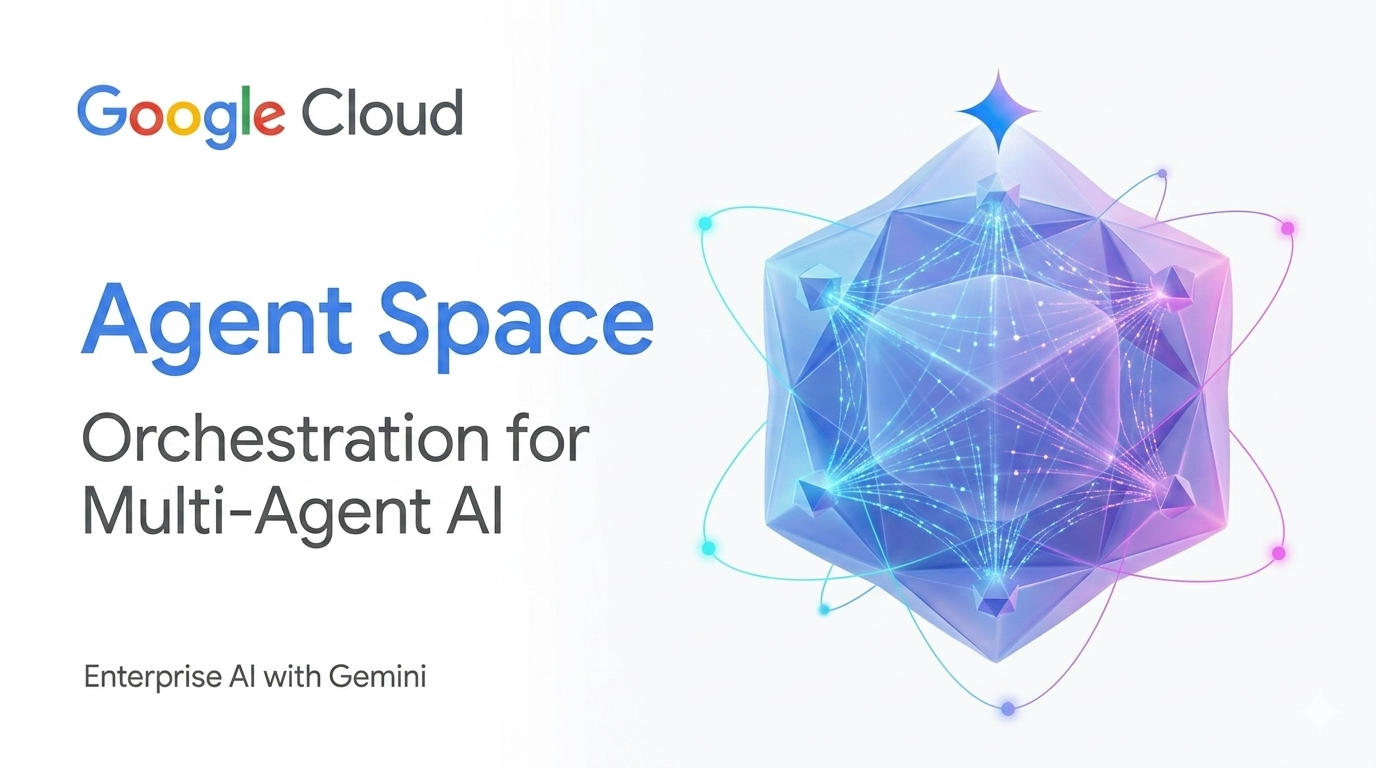
As enterprise AI evolves, organizations are moving from single AI assistants to coordinated AI systems that can plan, act, and execute work across tools. This shift introduces the concept of Agent Space.
Agent Space refers to an enterprise environment where multiple AI agents operate, interact, and complete tasks under defined business rules, data access policies, and governance frameworks. Instead of one AI responding to prompts, companies deploy networks of task-specific agents that collaborate to achieve outcomes.
For enterprises, this is less about chatbots and more about building an AI-enabled operational layer.
Agent Space is a structured environment where AI agents are:
An AI agent, in this context, is a system that can take actions toward a goal with some autonomy. It can retrieve data, trigger workflows, generate outputs, and interact with software systems.
A useful breakdown:
AI model → provides intelligence
AI agent → applies intelligence to tasks
Agent Space → coordinates many agents in a controlled environment
This distinction matters because enterprises rarely need just intelligence; they need controlled execution.
Several trends are pushing enterprises toward agent-based systems:
Growing process complexity
Modern workflows span multiple platforms. Humans often act as the “integration layer.” Agents can reduce that burden.
Demand for automation beyond rules
Traditional automation handles predictable logic. Many business tasks involve judgment, context, and variable inputs. Agents extend automation into these areas.
Pressure for operational efficiency
Enterprises want scalable ways to handle volume without linear headcount growth.
AI maturity inside organizations
Once companies see value from generative AI, they look for deeper operational applications. Agent ecosystems are a natural progression.
A real enterprise Agent Space usually includes several layers.
Enterprises do not deploy one general agent for everything. They create role-based agents such as:
Each has a defined scope. Narrow roles improve reliability and governance.
An orchestration layer determines:
This enables multi-step execution. For example, one agent gathers data, another analyzes it, and another formats a report.
Without orchestration, agents remain isolated tools.
Agents derive value from access to relevant data. Typical connections include:
Access must follow permission structures. Agents should not bypass existing security models.
Agent Space requires strong governance. Enterprises implement:
Governance is often the deciding factor between pilot success and scaled adoption.
Agent Space becomes tangible when tied to business scenarios.
Customer support operations
One agent classifies tickets, another retrieves solutions, and another drafts responses. Human agents review and finalize. This shortens resolution times and improves consistency.
Sales and revenue operations
Agents can qualify leads, update CRM records, generate summaries, and flag opportunities. Sales teams spend less time on admin tasks.
Knowledge management
Agents retrieve, summarize, and cross-reference internal documents, helping employees locate accurate information quickly.
Finance workflows
Invoice validation, anomaly detection, and approval routing can be partially automated by agents operating within defined thresholds.
IT service management
Agents triage requests, recommend fixes, and escalate complex cases to humans.
When designed correctly, Agent Space delivers:
Scalable execution
Agents handle volume spikes without proportional staffing increases.
Standardization
Processes follow consistent logic across regions and teams.
Faster cycle times
Decisions and actions occur closer to real time.
Operational visibility
Centralized monitoring provides insight into process performance.
However, these gains depend on design quality and governance discipline.
Agent Space is often built on broader AI stacks. Enterprises working within ecosystems like Google typically combine:
The model provides reasoning.
The agent executes tasks.
The Agent Space coordinates activity.
This layered approach is what enables enterprise-grade deployment.
Agents eliminate human roles
In reality, they shift human work toward oversight, exceptions, and strategy.
Agent systems are self-managing
They require ongoing tuning, policy updates, and monitoring.
More agents equal more value
Poorly coordinated agents can create noise and risk.
Agent Space is only for tech firms
Many industries adopt agent frameworks through partners and managed services.
Organizations typically consider it when:
Smaller teams with simple processes may not benefit immediately.
Enterprises usually mature into Agent Space gradually:
Phase 1
Use AI assistants for productivity.
Phase 2
Automate well-defined workflows.
Phase 3
Introduce task-specific agents.
Phase 4
Coordinate agents in structured environments.
This progression reduces risk and builds internal capability.
Agent Space represents a shift from AI as a tool to AI as an operational capability. It allows enterprises to deploy networks of agents that execute work under policy, oversight, and strategic direction.
The organizations that gain the most treat Agent Space as infrastructure, not a quick feature. Clear processes, clean data, and governance discipline determine success more than model quality alone.