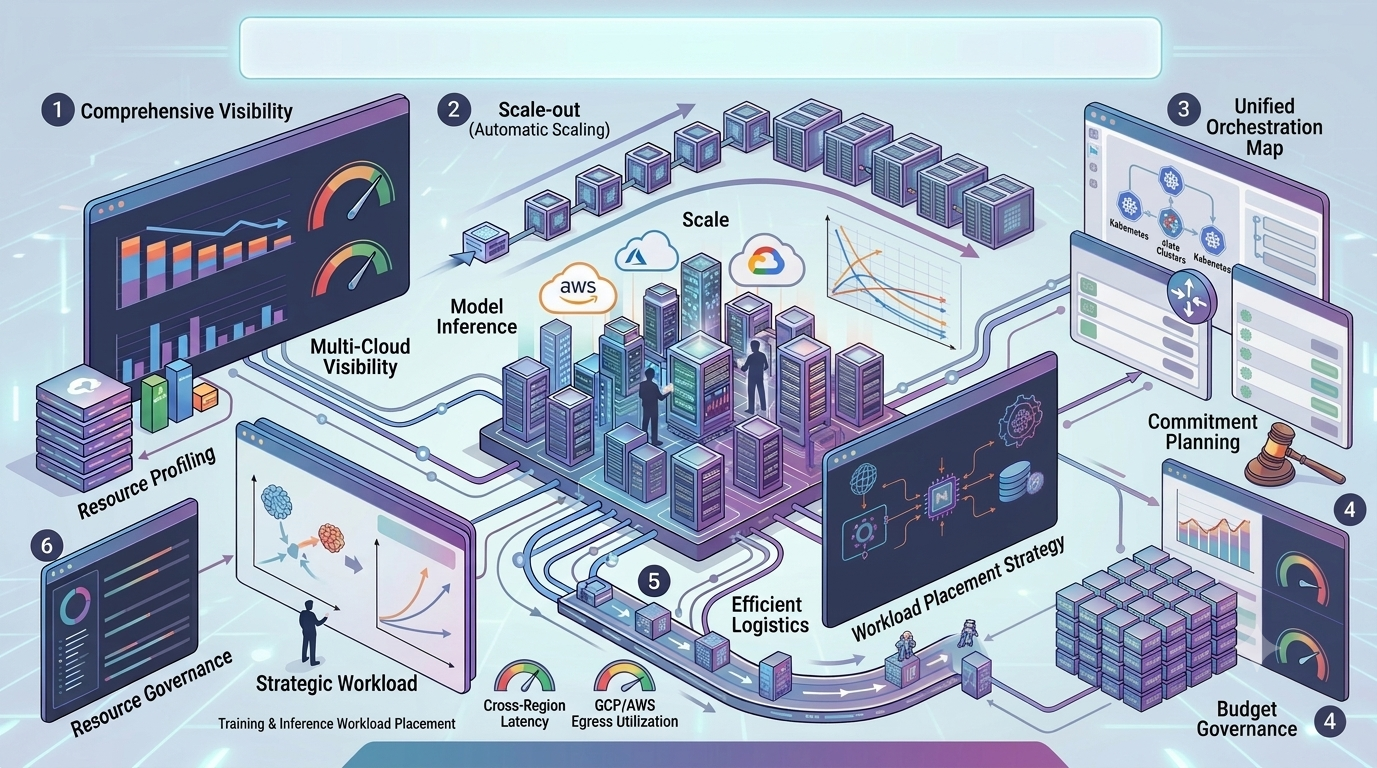
Multi-Cloud Governance Framework: Managing Security, Compliance, and Costs Across AWS, Azure, and GCP
Transcloud
August 14, 2026
Quick Answer
A multi-cloud governance framework is a structured operating model that controls security, compliance, and cost management across AWS, Azure, and Google Cloud Platform (GCP). It standardizes policies, identity management, monitoring, and financial controls across environments to reduce risk and prevent fragmentation. Without governance, multi-cloud environments typically suffer from inconsistent IAM policies, uncontrolled cost growth, and compliance gaps.
Key Takeaways
Multi-cloud governance is a control layer, not a tooling layer.
IAM consistency is the foundation of security governance.
Compliance requires centralized policy enforcement across all clouds.
Cost governance (FinOps) must be integrated into architecture decisions.
Observability across clouds is essential for operational control.
Governance must be continuous, automated, and policy-driven.
Why Multi-Cloud Governance Becomes Mandatory
As enterprises expand across AWS, Azure, and GCP, each platform introduces its own:
Identity systems
Security models
Billing structures
Monitoring tools
Compliance frameworks
Without a unified governance layer, organizations face:
Policy inconsistencies
Shadow IT growth
Uncontrolled cloud spend
Fragmented security posture
Audit failures
Governance is required to restore consistency across distributed environments.
1. Identity and Access Governance (IAM Layer)
Identity is the most critical control point in multi-cloud environments.
Core principles:
Centralized identity provider (SSO)
Least privilege enforcement across all clouds
Role standardization across AWS, Azure, and GCP
Service account lifecycle management
Common failure:
Different IAM models per cloud lead to inconsistent access control policies.
2. Policy-as-Code Enforcement
Manual governance does not scale in multi-cloud systems.
Approach:
Define policies as code
Apply version control to security rules
Enforce automatically during deployment
Tools:
AWS Config Rules
Azure Policy
GCP Organization Policy Service
This ensures uniform compliance enforcement across environments.
3. Security Governance Layer
Security must be standardized across clouds.
Key controls:
Encryption at rest and in transit
Centralized key management (KMS integration)
Unified threat detection systems
Standard firewall and network policies
Challenge:
Each cloud has different security primitives, requiring abstraction through governance policies.
4. Compliance and Regulatory Alignment
Enterprises must comply with frameworks such as:
ISO 27001
SOC 2
GDPR (where applicable)
India DPDP Act (for Indian data subjects)
Governance requirement:
Data classification across all clouds
Region-level data residency enforcement
Audit-ready logging pipelines
5. FinOps and Cost Governance
Cost control must be embedded into governance, not treated separately.
Core practices:
Unified billing visibility across AWS, Azure, and GCP
Standard tagging model for cost allocation
Budget enforcement per team/project
Continuous cost anomaly detection
Common issue:
Each cloud operates independent billing models, making consolidation essential.
Without centralized observability, root cause analysis becomes slow and incomplete.
7. Resource Standardization and Tagging Strategy
Resource sprawl is a major governance failure point.
Required standards:
Consistent tagging schema across clouds
Mandatory metadata fields:
Environment
Owner
Application
Cost center
Benefit:
Enables cost tracking, compliance mapping, and operational clarity.
8. Network and Connectivity Governance
Cross-cloud networking introduces hidden risks and costs.
Key controls:
Approved cross-cloud communication paths
Controlled egress and ingress policies
Standardized VPN / interconnect usage
Issue:
Uncontrolled cross-region traffic leads to both security and cost problems.
9. Automation and Lifecycle Management
Governance cannot rely on manual enforcement.
Automation areas:
Resource provisioning via Infrastructure as Code
Automated policy checks during deployment
Scheduled cleanup of unused resources
Auto-remediation of violations
10. Data Governance Layer
Data consistency is critical in multi-cloud environments.
Requirements:
Unified data classification model
Data lineage tracking
Retention and deletion policies enforced across clouds
Controlled replication rules
Multi-Cloud Governance Architecture
A mature governance model typically includes:
Central identity provider (SSO)
Policy-as-code engine
FinOps layer (cost management)
Central logging and observability platform
Security monitoring system
Infrastructure provisioning pipeline (IaC)
This creates a control plane over distributed cloud environments.
Governance Maturity Model
Level
Description
Control Strength
Level 1
Ad-hoc governance
Low
Level 2
Cloud-specific policies
Medium
Level 3
Standardized governance model
Good
Level 4
Automated enforcement
Strong
Level 5
Continuous governance system
Enterprise-grade
Common Multi-Cloud Governance Failures
1. Cloud silos
Each team manages its own cloud independently.
2. Inconsistent IAM policies
Different access models across AWS, Azure, and GCP.
3. Lack of unified cost visibility
FinOps separated per cloud provider.
4. Manual compliance checks
Audit processes not integrated into pipelines.
5. Uncontrolled resource sprawl
Unused resources accumulate across environments.
Implementation Roadmap
Phase 1: Standardization
Define IAM and tagging standards
Establish identity provider integration
Set baseline security policies
Phase 2: Centralization
Consolidate logging and monitoring
Implement unified cost visibility
Align compliance frameworks
Phase 3: Automation
Introduce policy-as-code enforcement
Automate resource lifecycle management
Enable real-time monitoring
Phase 4: Optimization
Continuous FinOps integration
Automated security remediation
Governance-driven architecture decisions
Frequently Asked Questions
What is multi-cloud governance?
It is a structured framework that manages security, compliance, and cost across multiple cloud providers.
Why is governance important in multi-cloud?
Because each cloud has different policies, tools, and billing systems, creating inconsistency without a unified framework.
What is the biggest risk in multi-cloud environments?
IAM misconfiguration and lack of centralized visibility.
Can governance be automated?
Yes, through policy-as-code, infrastructure automation, and centralized monitoring.
Is multi-cloud always better than single cloud?
Not always; it increases complexity and requires strong governance to be effective.
Final Thoughts
Multi-cloud governance is the foundational layer that determines whether AWS, Azure, and GCP environments operate as a coordinated system or as fragmented silos.
Organizations that implement standardized IAM, centralized observability, FinOps integration, and policy-as-code enforcement achieve significantly better security posture, cost efficiency, and operational stability.
Without governance, multi-cloud becomes an unmanaged collection of isolated systems rather than a controlled enterprise architecture.
Stay Updated with Latest Blogs
You May Also Like
Go beyond cloud migration by mastering GCP cost management and optimizing BigQuery for maximum efficiency.
We use cookies to ensure that we give you the best experience on our website. If you continue to use this site we will assume that you are happy with it.Ok