Transcloud
September 1, 2026
September 1, 2026

Cloud costs rarely become a problem overnight.
The first sign is usually a bill that is higher than expected. A sudden increase in spend triggers an investigation, teams look for obvious waste, a few unused resources are removed, and the next bill is expected to improve.
But then it happens again.
This is where many organizations get cloud cost management wrong. They react to the bill instead of addressing the decisions and processes that created it.
Cloud FinOps provides a more structured approach. It brings together finance, engineering, and business teams to understand cloud spending, improve accountability, and make better decisions about resource usage.
The goal is not simply to reduce the monthly cloud bill. It is to reduce the total cost of ownership (TCO) while ensuring cloud investments continue to support performance, reliability, and business growth.
Here is a practical seven-step approach to implementing Cloud FinOps and identifying opportunities for immediate TCO reduction.
You cannot optimize what you cannot see.
The first step is to create visibility across your cloud environment. This means understanding where money is being spent, which teams or applications are responsible, and what is driving cost increases.
Start by breaking down cloud costs by:
A large cloud bill with no ownership structure makes optimization difficult. Teams may see the total spend, but they cannot identify who is responsible for it.
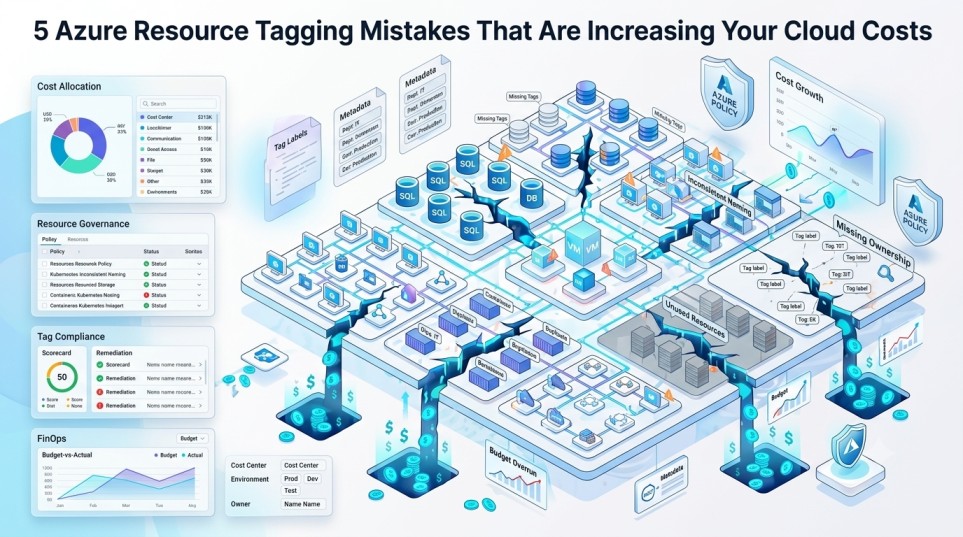
A proper tagging and allocation strategy is essential here. Every significant resource should be linked to a relevant application, team, project, or business function wherever possible.
This gives organizations the foundation required for better cloud cost visibility and accountability.
Once cost visibility is established, the next step is to identify spending that provides little or no business value.
This is often where the fastest savings opportunities can be found.
Look for:
These are relatively straightforward opportunities because the goal is not to change architecture or compromise performance. It is to stop paying for resources that are not delivering sufficient value.
For many organizations, this first round of optimization can create immediate TCO reduction while providing a clearer picture of broader inefficiencies.
Overprovisioning is one of the most common reasons cloud costs remain unnecessarily high.
Teams often select larger instance sizes to avoid potential performance problems. The workload grows differently than expected, but the resource configuration remains unchanged.
Over time, organizations accumulate infrastructure that is significantly larger than what workloads actually require.
Review resource utilization and compare it with the capacity being paid for.
Focus on:
The objective is not to make every resource as small as possible.
It is to match resources with actual workload requirements.
Right-sizing can reduce unnecessary spending without affecting performance when decisions are based on real usage data.
Not every workload should use the same cloud pricing model.
Organizations often pay on-demand rates for workloads that run continuously and have predictable usage. Others commit to long-term capacity for workloads that change frequently.
Both approaches can increase TCO.
Cloud FinOps requires organizations to understand workload patterns before making commitment decisions.
Consider:
The right pricing model depends on the workload.
Before making long-term commitments, teams should understand baseline usage and future requirements. A discount does not create savings if the organization commits to capacity it does not actually need.
Cloud cost management cannot sit entirely with the finance team.
Finance teams understand budgets and business priorities, but engineering teams make many of the technical decisions that determine cloud consumption.
Cloud FinOps brings these functions closer together.
Engineering teams need access to cost information that helps them understand the financial impact of their decisions. Finance teams need visibility into why costs exist and how they support the business.
Shared ownership can be strengthened by:
The goal is not to make engineers responsible for cutting costs at all times.
It is to ensure cost becomes one of the factors considered when building and operating cloud workloads.
Cloud environments change constantly.
New resources are deployed, workloads scale, applications evolve, and teams experiment with new services. A one-time cost optimization project will eventually lose its impact if there is no ongoing monitoring.
Organizations should establish controls that detect unusual or inefficient spending early.
This can include:
The earlier a cost issue is identified, the easier it is to control.
Continuous monitoring helps organizations move beyond reacting to unexpected bills and toward proactive cloud cost management.
A lower cloud bill does not always mean a lower total cost of ownership.
For example, reducing infrastructure capacity may lower direct cloud spending but increase application downtime or operational effort. Similarly, a cheaper architecture may create higher maintenance costs over time.
Cloud FinOps should therefore look beyond the monthly invoice.
A broader TCO view can include:
This helps organizations make better optimization decisions.
The objective is to achieve the right balance between cost, performance, reliability, and business value.
The biggest shift in Cloud FinOps is moving from reaction to continuous improvement.
Bill shock is usually a symptom.
The underlying issue may be poor visibility, unclear ownership, inefficient resource sizing, the wrong pricing commitments, or a lack of ongoing controls.
A practical Cloud FinOps approach addresses these issues systematically:
These steps do not require organizations to rebuild their entire cloud environment before seeing results.
In many cases, immediate savings can begin with better visibility and the removal of obvious waste. The longer-term value comes from building FinOps practices into everyday cloud decisions.
Cloud cost optimization should not begin when the bill becomes a problem.
By the time an organization experiences bill shock, the underlying inefficiencies may already have been building for months.
Cloud FinOps provides a way to make cloud costs visible, measurable, and manageable across the organization.
The immediate opportunity is to identify and eliminate waste. The larger opportunity is to reduce TCO over time by making cost efficiency part of how cloud infrastructure is designed, purchased, and operated.
That is the difference between fixing one expensive bill and building a cloud environment that remains financially efficient as it grows.