Transcloud
April 15, 2026
April 15, 2026
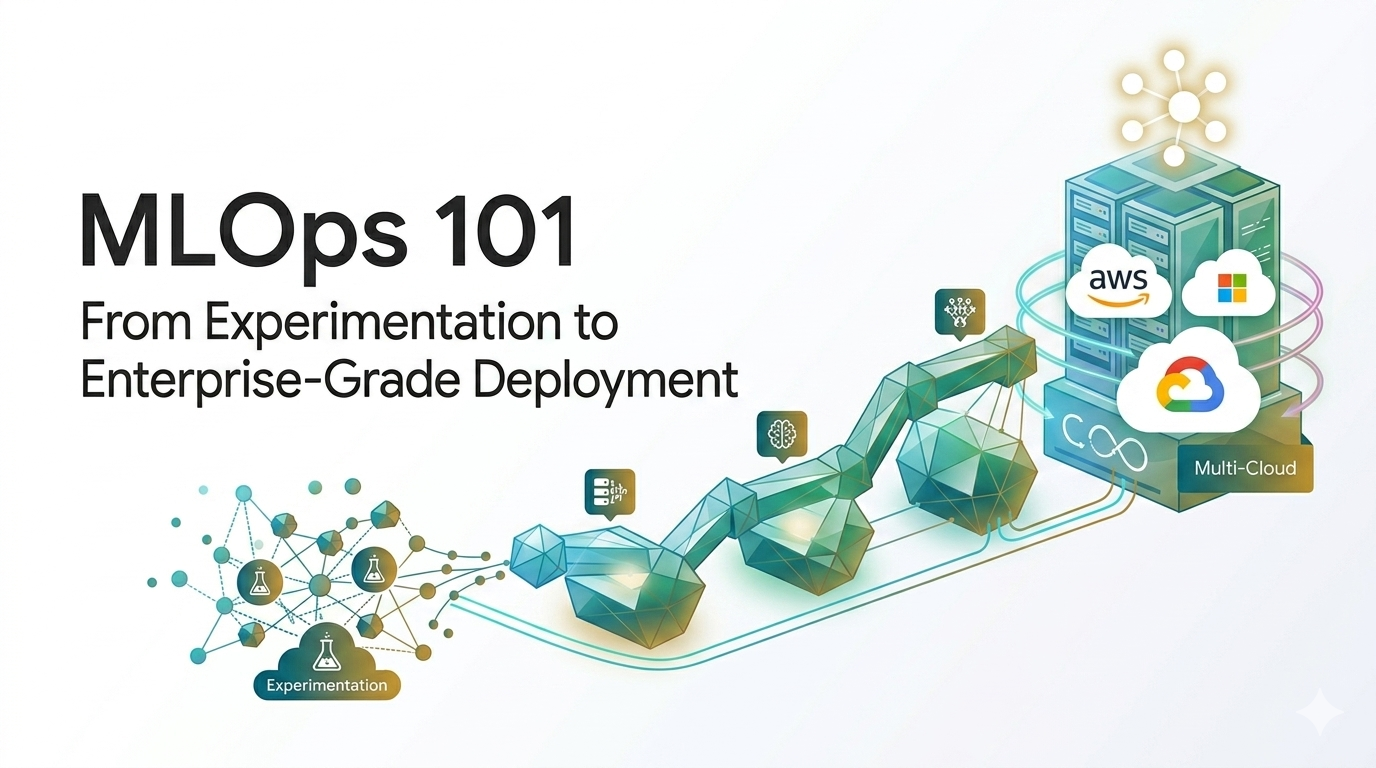
Most machine learning teams are great at experimentation — building models, testing hypotheses, exploring datasets. But very few organizations excel at turning those experiments into reliable, production-grade AI systems.
That gap between “I built a model” and “the model delivers business value at scale” is exactly where MLOps lives.
MLOps is not just an engineering discipline. It is the connective tissue that gives ML repeatability, governance, scalability, and performance guarantees — the things enterprises expect from any mission-critical system.
This guide breaks down the essential components of MLOps, what it fixes, and how teams can evolve from notebooks to production-grade AI pipelines.
ML models are fundamentally different from traditional software.
They learn, evolve, drift, and deteriorate. Their performance depends on continuously changing data, environments, and business rules. Without a framework to operationalize them, most models:
This is why industry estimates consistently show that 70–85% of ML projects never reach production, and even those that do often fail to scale or maintain reliability over time.
MLOps solves this by turning ML into a continuous lifecycle, not a one-time deployment.
Before MLOps, most teams operate in an ad-hoc sequence:
Data → Experiment → Train → Deploy (Once)
MLOps replaces this with a structured loop:
Data → Validation → Training → Versioning → Deployment → Monitoring → Retraining → Release
Each stage has tooling, automation, and governance behind it.
The result: every model is reproducible, traceable, measurable, and maintainable.
MLOps is often misunderstood as “CI/CD for ML,” but its scope is much wider.
It addresses several systemic issues:
Ensures that experiments can be re-created exactly — datasets, features, parameters, environments, and code.
Provides standardized deployment practices across clouds, clusters, environments, and teams.
Tracks model performance and feature distribution shifts in real-time.
Orchestrates distributed training, GPU/TPU management, autoscaling, and multi-cloud execution.
Implements lineage, auditability, access control, and compliance.
Right-sizes compute, storage, feature pipelines, and inference environments.
In short: MLOps makes ML reliable enough for the enterprise.
Most mature MLOps strategies stand on five pillars.
These pillars convert ML from fragile experimentation into a stable production system.
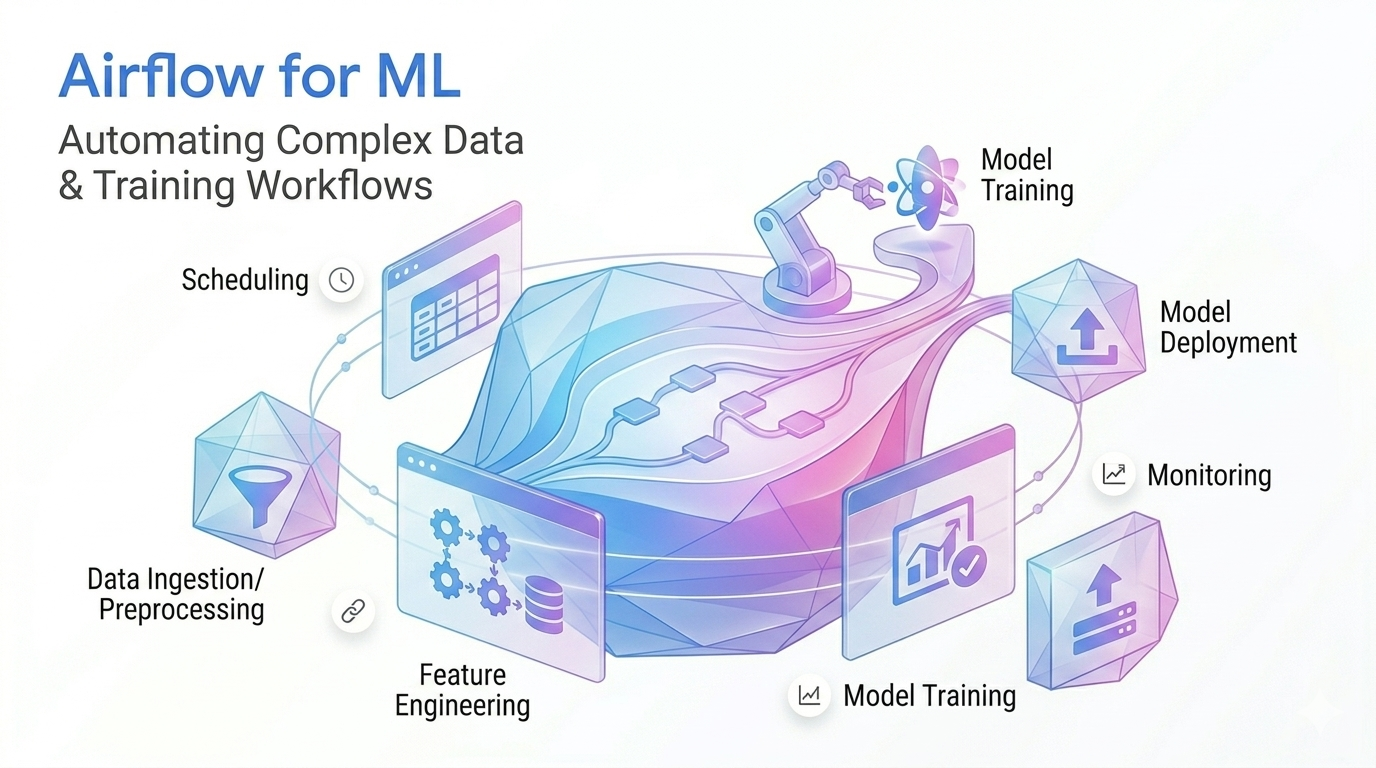
End-to-end automation ensures that data ingestion, validation, training, testing, and deployment are not manual processes.
Tools include:
This eliminates one-off scripts and introduces consistent execution.
Enterprises need every version of a model and corresponding dataset stored, tracked, and traceable.
This includes:
Popular tools: MLflow, DVC, Weights & Biases, Git-based tracking.
Deploying a model once is easy; deploying it safely, repeatedly, and at scale is the real challenge.
Enterprises rely on:
These patterns ensure that new models don’t break production.
Monitoring is not just about CPU or latency — ML requires domain-specific checks:
These feed into automated retraining pipelines, keeping models fresh and aligned with real-world patterns.
Enterprises must answer:
MLOps ensures full lineage, access control, and governance logs.
This is non-negotiable for BFSI, healthcare, and regulated sectors.
Each cloud provider offers its own MLOps ecosystem:
Multi-cloud organizations often standardize on Kubernetes + Kubeflow/Airflow, and use cloud-native services for compute acceleration and storage optimization.
The design principle remains the same:
modular pipelines + continuous monitoring + automated retraining.
For teams starting from scratch, the goal is not to build everything at once.
It’s to progressively introduce structure and automation.
Use experiment trackers. Enforce dataset versioning. Capture metadata.
Convert notebooks into pipeline components — no more manual runs.
Validate models automatically before deployment.
Adopt canary or shadow deployments to minimize risk.
Log predictions, track drift, monitor latency and accuracy.
Trigger retraining when drift, data quality, or business KPIs degrade.
Layer on security, audit trails, documentation, and access control.
This roadmap helps teams evolve from chaos to predictable, scalable operations.
ML experiments don’t deliver business value.
ML systems do.
MLOps is the discipline that transforms ML from isolated experiments into production-grade, scalable, cost-efficient, trustworthy systems that enterprises can rely on.
In 2025, the organizations succeeding with AI are not the ones training the most models —
they’re the ones building repeatable, monitored, automated pipelines that keep those models alive, healthy, and impactful.
At Transcloud, we help companies set up end-to-end MLOps foundations across Google Cloud, AWS, and Azure, so ML doesn’t just get deployed — it delivers.