Transcloud
May 6, 2026
May 6, 2026
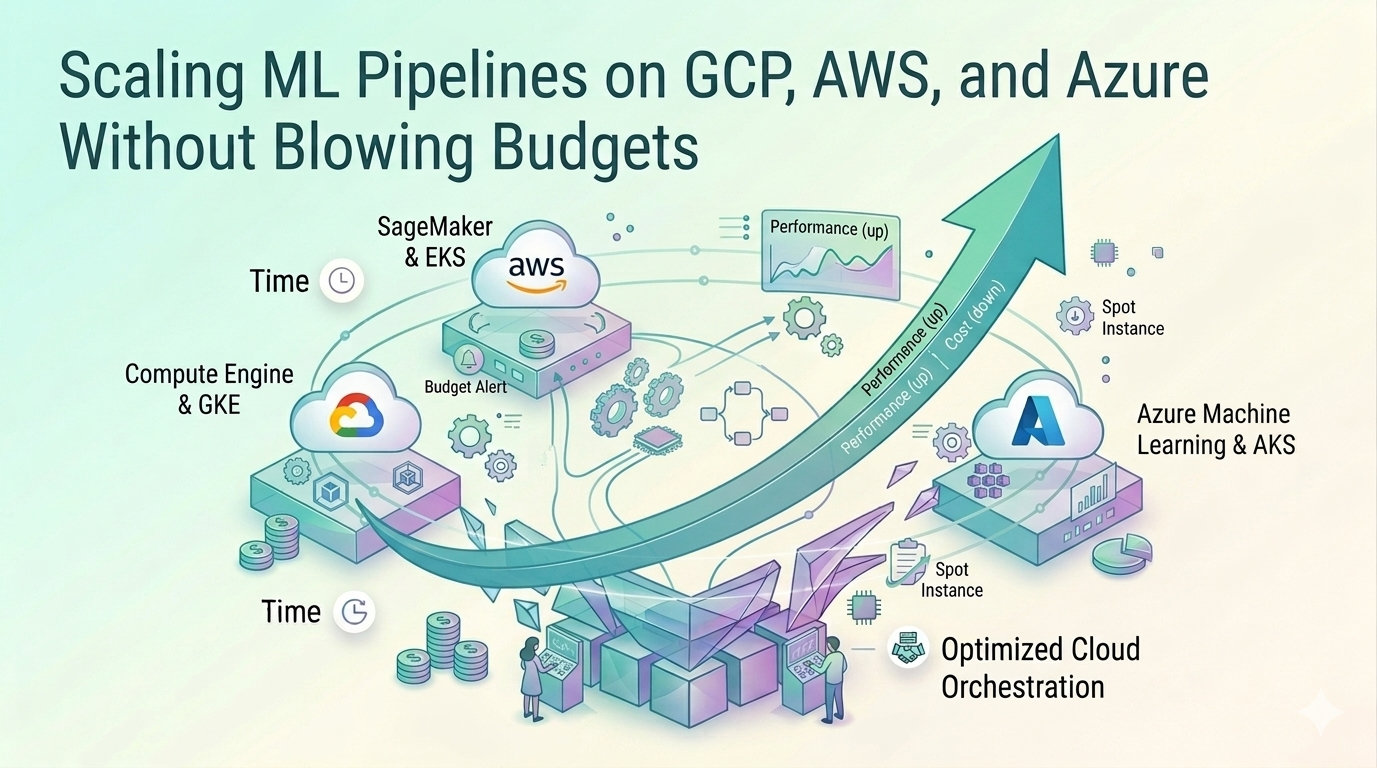
As enterprises expand their AI initiatives, the challenge is no longer just building accurate models — it is scaling ML pipelines across multiple clouds while keeping costs predictable. Large datasets, distributed training jobs, feature engineering pipelines, and model deployment environments can quickly overwhelm budgets if not managed strategically. Multi-cloud deployments provide flexibility and resilience, but without proper controls, they can also magnify inefficiencies and waste.
Many organizations adopt hybrid or multi-cloud strategies to avoid vendor lock-in, leverage best-of-breed services, or optimize for latency and regional compliance. For example, a company might train models on GCP Vertex AI for high-performance TPUs, use AWS Sagemaker for batch inference jobs, and deploy real-time endpoints on Azure ML to remain close to customer data. While this approach maximizes capabilities, it introduces complexity:
According to a 2024 Gartner survey, over 60% of enterprises report multi-cloud ML initiatives exceeding budgets due to hidden operational costs. Even when models perform optimally, overspending in compute or storage can erode ROI.
Orchestrating ML workflows using Kubeflow Pipelines, Airflow, or Vertex Pipelines allows teams to standardize pipelines across clouds. Defining workflow logic independently of the underlying infrastructure reduces duplication and ensures reproducibility. Declarative orchestration prevents “pipeline sprawl” and allows centralized monitoring of execution and resource utilization.
Autoscaling is critical. Each cloud provider offers flexible options:
Scaling compute resources dynamically to match the workload ensures that ML pipelines consume only what is necessary, avoiding idle spend while maintaining performance.
Moving data between clouds is costly. Strategies include:
By minimizing inter-cloud transfers, organizations can significantly reduce unexpected bills while keeping pipelines responsive.
Maintaining metadata consistency across clouds is essential. Tools like MLflow, Vertex AI Metadata, or SageMaker Experiments help teams track model versions, dataset snapshots, and hyperparameters. Centralized tracking reduces redundant experiments, ensuring compute is spent efficiently.
Real-time visibility into resource utilization prevents budget overruns. Monitoring GPU/TPU usage, pipeline execution times, and cloud spend at the workflow level allows teams to identify inefficiencies and optimize cluster sizing, storage allocations, and training schedules.
Scaling ML pipelines is not simply a technical challenge; it is a financial and operational discipline. Enterprises that achieve sustainable growth in AI:
Applied consistently, these strategies allow organizations to scale pipelines without sacrificing model accuracy or incurring runaway costs.
Modern MLOps platforms simplify scaling across clouds:
Combined with IaC tools like Terraform, these platforms enable repeatable, governed infrastructure provisioning, ensuring pipelines are consistent across regions and providers. The integration of orchestration, monitoring, and cost optimization within a platform reduces operational overhead and strengthens ROI.
Scaling ML pipelines on GCP, AWS, and Azure is a strategic capability, not just a technical task. By combining cloud-agnostic orchestration, dynamic compute allocation, data efficiency, and strong observability, enterprises can expand AI initiatives without blowing budgets. Thoughtful MLOps implementation ensures that models remain performant, pipelines stay reproducible, and investments in AI generate tangible, cost-effective business impact.