
Transcloud
June 15, 2026
June 15, 2026
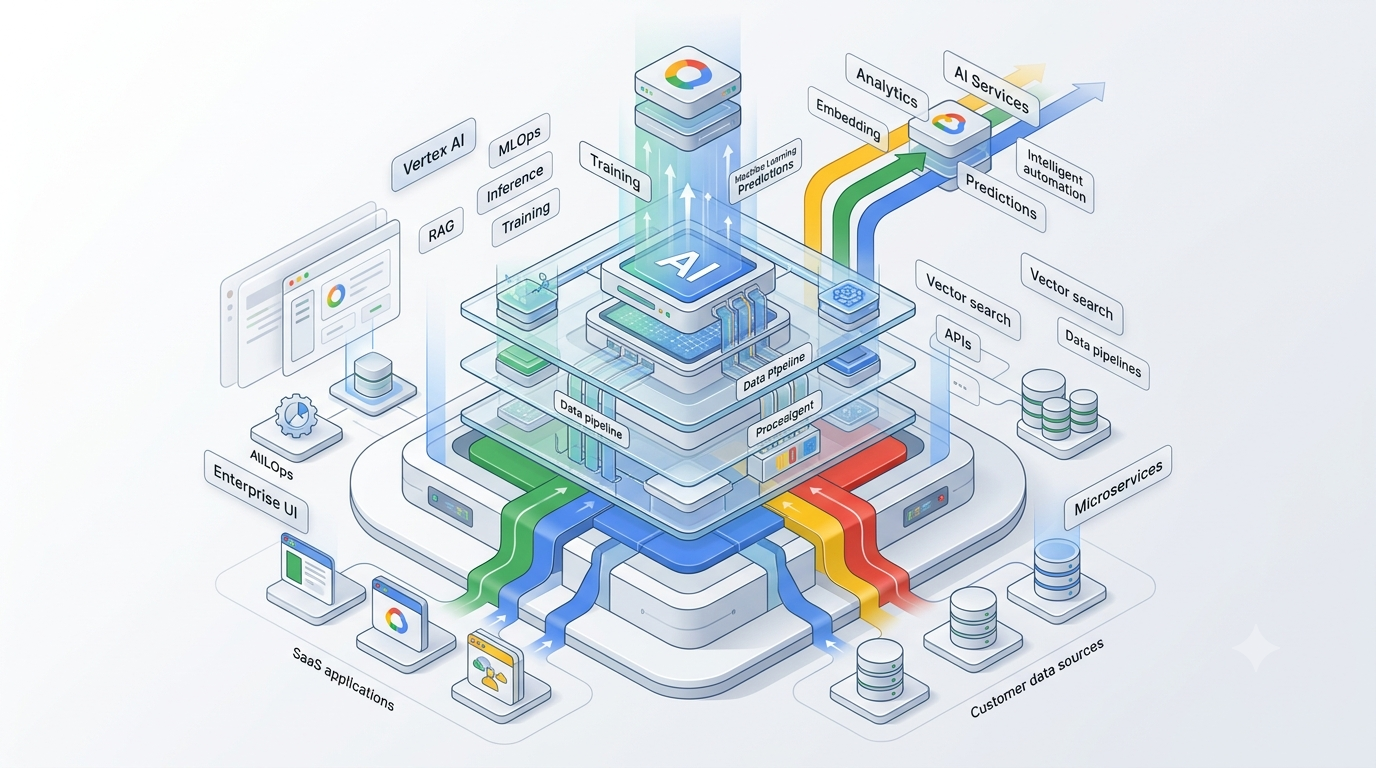
Vertex AI is Google Cloud’s unified machine learning and generative AI platform that enables SaaS companies to build, deploy, and scale AI-powered features without managing underlying infrastructure. For enterprise SaaS platforms, it supports use cases such as predictive analytics, recommendation systems, intelligent search, and generative AI copilots. A successful implementation requires structured data pipelines, model governance, cost control, and integration with existing application architecture.
SaaS platforms are increasingly competing on intelligence rather than just features. Customers expect built-in analytics, predictive insights, and AI-driven workflows as standard functionality.
Google Cloud’s Vertex AI provides a managed environment to build and deploy machine learning and generative AI models at scale without requiring teams to manage infrastructure complexity.
For SaaS companies, this shifts AI adoption from experimental projects to production-grade systems embedded into core product workflows.
Vertex AI is a unified AI and machine learning platform that provides:
It is designed to reduce operational complexity while supporting enterprise-scale AI workloads.
SaaS platforms use Vertex AI to personalize user experiences.
Examples include:
AI models can forecast:
This enables SaaS companies to proactively engage users.
Vertex AI supports semantic search using embeddings and vector databases.
This improves:
Generative AI models can power:
This reduces support workload and improves response times.
AI can automate internal SaaS workflows such as:
A typical enterprise architecture includes:
This architecture ensures scalability and separation of concerns between application logic and AI processing.
Start by identifying high-impact use cases such as:
Each use case should map to measurable business outcomes.
AI performance depends heavily on data quality.
Key requirements:
Tools commonly used with Vertex AI include BigQuery and Cloud Storage.
Feature engineering transforms raw data into model-ready inputs.
Best practices:
Vertex AI supports both:
Validation should include:
Models can be deployed using:
Production deployment should include:
AI models are typically exposed via APIs.
Integration considerations:
Enterprise AI systems require continuous monitoring.
Key metrics:
AI workloads can become expensive without governance.
Common cost drivers include:
Enterprise SaaS platforms must ensure:
Vertex AI integrates with Google Cloud IAM and security services to enforce these controls.
AI models fail when training data is incomplete or inconsistent.
Without pipelines, models cannot be reliably updated or monitored.
Starting with overly complex models slows down deployment.
Inference costs can scale unexpectedly in production.
AI should be tied to measurable SaaS outcomes.
| Factor | Traditional ML Stack | Vertex AI |
| Infrastructure Setup | Manual | Managed |
| Deployment | Complex | Simplified |
| Scaling | Hard | Automatic |
| MLOps | Custom-built | Integrated |
| Time to Production | Slow | Fast |
| Cost Control | Manual | Tool-assisted |
It is used for building and deploying machine learning and generative AI features such as recommendations, predictions, and intelligent search.
Yes, but cost management is important. It is most effective when there is clear product-market fit for AI features.
Yes, it integrates with foundation models for generative AI use cases.
Both provide similar capabilities; differences lie in ecosystem integration and tooling preferences.
Data engineering, machine learning, MLOps, and cloud architecture skills are typically required.
Vertex AI enables SaaS companies to operationalize AI without building complex infrastructure from scratch. However, success depends less on the platform itself and more on data quality, architecture design, and operational discipline.
Enterprises that combine Vertex AI with strong MLOps practices, governance frameworks, and FinOps monitoring can move from experimental AI projects to scalable, revenue-generating product features.
For SaaS platforms competing in global markets, this shift is becoming a core differentiator rather than an optional enhancement.