Transcloud
August 3, 2026
August 3, 2026
Cloud was supposed to reduce costs. But for many teams running on AWS—and increasingly across Azure and GCP—costs quietly spiral without clear visibility.
If your monthly bill feels unpredictable or consistently higher than expected, the issue usually isn’t usage alone. It’s hidden inefficiencies baked into how your cloud is set up and managed.
Most teams look at total spend, not where waste actually happens. Across AWS, Azure, and GCP, the same patterns show up:
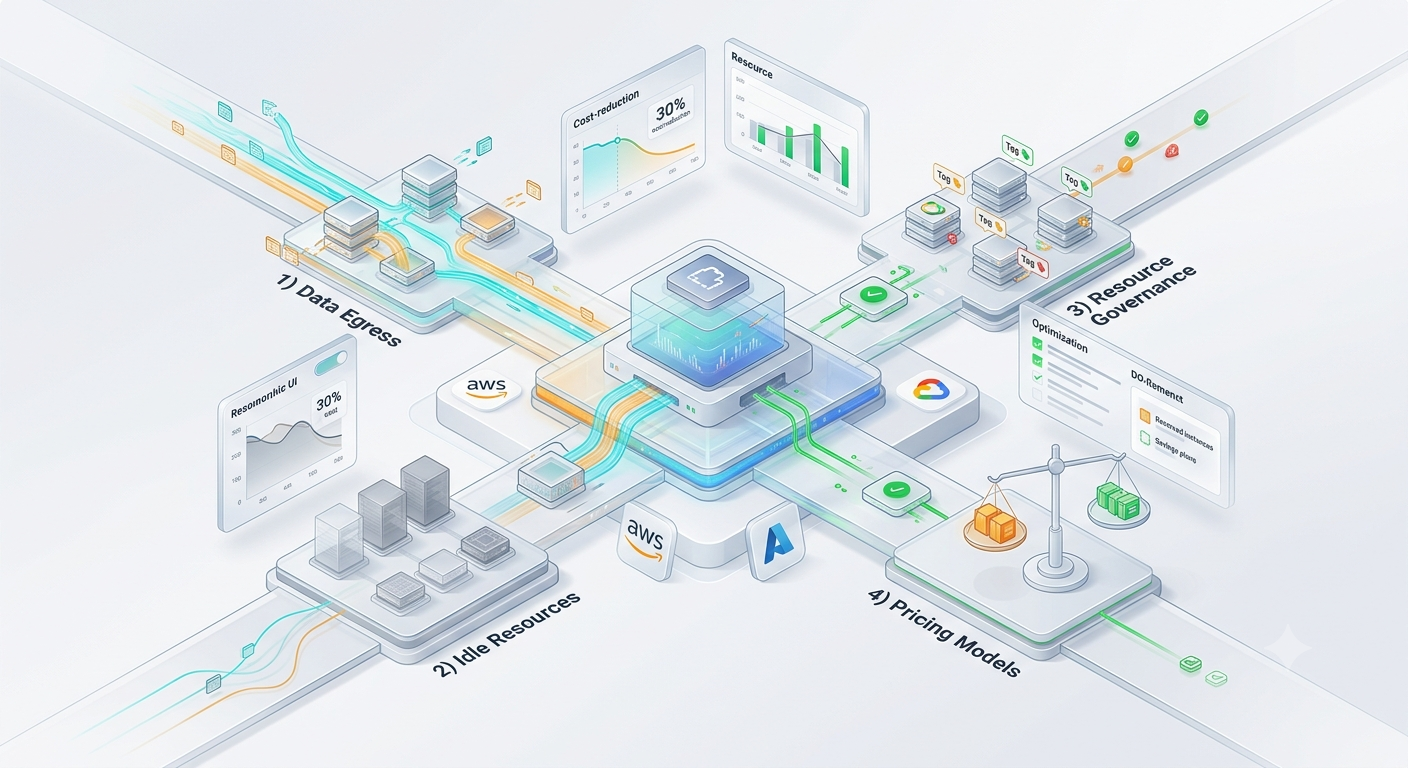
Moving data out of cloud environments (or between regions/clouds) is one of the most underestimated expenses.
These costs don’t scale linearly—they spike with usage.
This is the most common issue.
You’re paying for capacity, not actual usage.
Without proper tagging and ownership:
This becomes worse in multicloud environments where each platform has different structures.
4. On-Demand Everything
Many teams never move beyond on-demand pricing.
This alone can inflate costs by 20–40%.
When you operate across AWS, Azure, and GCP:
So instead of optimizing, teams duplicate inefficiencies across clouds.
Fixing cloud cost issues isn’t about cutting usage randomly. It’s about structured optimization.
You need a unified view of:
Without this, optimization is guesswork.
Manual cleanup doesn’t scale.
Shift critical workloads strategically:
If you want quick impact, start here:
These steps alone can reduce costs significantly.
Even after identifying issues:
So optimization remains “planned” but never executed.
Cloud cost optimization is not a one-time fix. It’s an ongoing discipline—especially in a multicloud environment.
The difference between a controlled cloud bill and a bloated one is usually not scale. It’s visibility, governance, and execution.